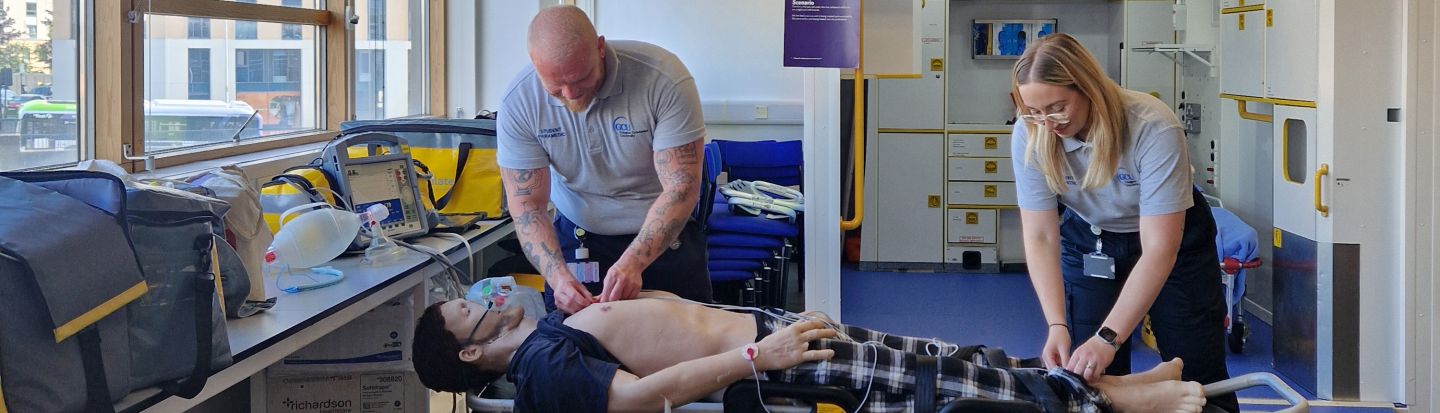
Overview
Advance your career in health and social care with a master’s qualification that strengthens your clinical practice, leadership and research skills.
Around the world, health and social care services are increasingly working together to better support individuals, families and communities. As expectations of professional practice continue to evolve, the need for master’s-level qualifications for registered health and social care practitioners is becoming more evident.
Designed for registered practitioners, our MSc Advanced Practice helps you build on your existing expertise. You will learn to apply your knowledge critically in areas such as:
- clinical assessment
- analysis and insight
- research
The course places service users and carers at the centre of clinical practice. You will critically examine how their perspectives can inform policy and enhance practice, while strengthening your professional skills in leadership and communication.
You will graduate prepared to step into advanced roles across the NHS, public and independent sectors with confidence.
You can complete the MSc Advanced Practice as a general degree, or choose to specialise in one of six specialist pathways.
Paramedicine Pathway
This page provides information about the Paramedicine pathway, one of six pathways available within our MSc Advanced Practice.
Please note: The Paramedicine pathway is available as a full-time or part-time study option, making it suitable for working professionals.
The MSc Advanced Practice (Paramedicine) pathway offers the opportunity for you to develop your career as a paramedic with an in-demand qualification offering advanced learning to underpin safe and effective practice.
While designed for paramedics, this course is also open to nurses, medics and allied health professionals working within paramedic services, supporting multidisciplinary career development.
This course recognises that advanced practitioners from a paramedicine background must demonstrate high-level decision-making and problem-solving skills in complex clinical situations. It requires advanced scholarship to underpin safe and effective practice when caring for the population.
Your masters experience will be focused on the four pillars of Advanced Practice:
- Clinical Practice
- Facilitation of Learning
- Leadership
- Evidence, Research and Development.
This approach recognises the variety and depth of the Paramedic role and its rapid evolution into a range of healthcare settings.
The course places service users and carers at the centre of advanced practice development. You will critically examine how their perspectives inform policy and practice development, while strengthening core professional skills like leadership and communication.
As part of the MSc Advanced Practice framework, you will be able to select from a wide range of modules to suit your personal, professional and employment goals.
Why study Advanced Practice (Paramedicine) at GCU?
- We address the diverse needs of learners and employing organisations, creating strong links to future paramedic career pathways.
- Proven record of delivering MSc education for paramedics in Scotland, taught by subject matter experts across the four pillars of practice.
- Strong links with the Royal College of Paramedics support the development of paramedic advanced practice across the UK.
- Learn in a dynamic interprofessional environment alongside a range of other healthcare professionals.
- A flexible approach supports clinicians to balance study with their employed roles.
What you will study
We aim to display the most up-to-date information possible.
The modules listed on this page and the Programme Specification are intended to give you an idea of what you may be able to study on this course. Please note that course content, modules, teaching and assessment may change each year and after you have accepted your offer to study at GCU. This might be because we are required to do so by law, by a governmental authority, regulator or accrediting body. We may also make changes for quality assurance reasons, or to enhance the course.
Core modules
Optional modules
Advanced Leadership for Health & Social Care Practitioners
Principles of Practice in Medical Ultrasound
Work-Based Advanced Skills and Innovative Practices 1
Work-Based Advanced Skills and Innovative Practices 2
Advanced Assessment and Management of Illness and Injury
Prescribing for Healthcare Practitioners
Social Action Approaches in Public Health
Applied Pathophysiology for Advancing Professional Practice
Infection Prevention & Control in a Global Context
Advanced Musculoskeletal Practice
Advancing Practice in Neurological Rehabilitation
Advancing Professional Practice
Recognition and Management of the Acutely Unwell Adult
Advanced Clinical Assessment and Decision Making in Acute and Primary Care
Human Movement and MSK Analysis
Supporting Anticipatory Care for Long Term Conditions
Diabetes Care - A Multi Professional Approach
Pathophysiology and Chronic Complications of Diabetes
The Lower Limb and Foot in Diabetes - Evaluation of Risk
Nutrition and Lifestyle Management of Diabetes
Topics in Diabetes Care and Management
Non-Medical Cystoscopy Theoretical Preparation
Artificial Intelligence for Health and Social Care Practitioners (L11)
Careers
The MSc Advanced Practice offers three exit awards (MSc, PgD and PgC) allowing flexible progression that aligns with your professional goals. Completion of the course supports progression into advanced and specialist roles, with increased responsibility and influence.
As a graduate, you will be prepared to practise at an advanced level within your specialism. Graduates typically progress their careers in the NHS, the UK private healthcare sector, or in their home countries.
Through the development of advanced skills, you’ll be ready to:
- lead interprofessional teams
- influence policy and practice development
- support service improvement
- design and deliver educational initiatives within your organisation.
Graduates from the Paramedicine pathway have gone on to work in roles across:
- NHS Health boards
- GP practices
- palliative care environments
- specialist ambulance service roles
- ambulance service
- AP roles in operations and as clinical advisors
- critical care roles
- healthcare charities.
Course information
Take a virtual tour with us
Download the programme specification
In addition to the core modules that all students must undertake, some courses offer students a choice from a selection of optional modules to shape the focus of their degree. Optional modules where available, form part of the overall credit structure of the course.
Download the programme specification for a detailed breakdown of the course structure, including modules, what you'll learn and other useful information.
Terms and Conditions