Digital Design students spark fresh energy into GCU survey
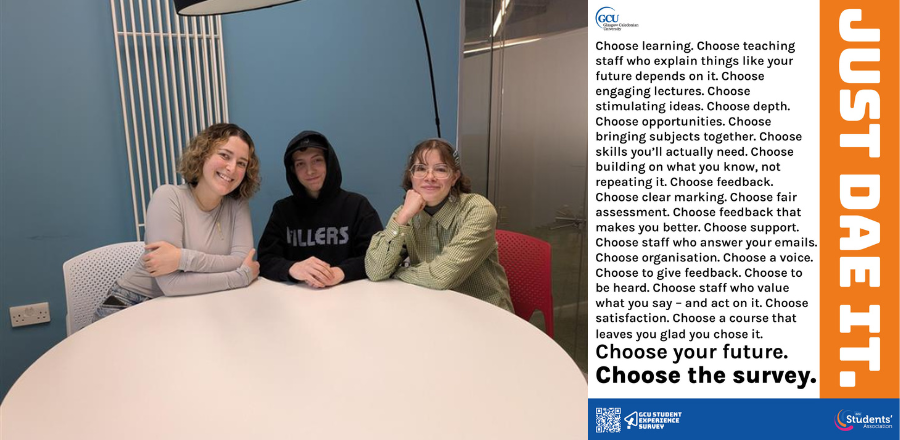
The power of collaborative thinking has helped a group of BSc Digital Design students kick-start a survey campaign at GCU.
The ‘Design for Change’ module tasked Ellie Janes, Ruaraidh Roberts and Megan Ryce to come up with a campaign in just five weeks to help promote the GCU Student Experience Survey, which officially launched last week.
The survey is designed to give non-final year Undergraduate students the chance to provide feedback on their experience at GCU. The campaign will run across campus and be featured on the university’s social media channels.
We caught up with Ellie, Ruaraidh and Megan to find out more:
Tell me a bit about the Design for Change module and what you were tasked with?
Megan: “We were given the challenge of encouraging students to fill out the Student Experience Survey. The university were keen to get more students involved and sharing their thoughts, so we had to think of something that would capture the attention of students who maybe didn’t think their involvement matters. We wanted to make it exciting and add some humour into it to help grab the attention of the students.”
Ellie: “The name of the module perfectly describes what we have to do – it’s about making designs to help encourage a specific change. The way our lecturer describes it is to first look at the issue going on – in this case it was that people weren’t participating. We then had to look at the specific thing to change in order to move that from a problem to a solution. That issue was the apathetic student feeling like their voice wasn’t powerful enough and their thoughts wouldn’t make a difference – which stems from not understanding the full process.”
Ruaraidh: “One of the other challenges was that people with strong opinions always give their opinions, whether it’s good or bad. Our challenge was to hear from the average student.”
How did you transform your ideas into the actual project?
Ellie: “We did our research into what the current offering of visual media around surveys was at the university. We recognised that they all looked quite similar and then we considered the challenge we had with the apathetic student. Instead of focusing on ‘you should really fill in this survey’, we opted for a more direct route and the way we would want to be spoken to as students.”
Ruaridh: “Our key idea was basically ‘don’t live in the past, we can’t evolve without your help’. The main thing we wanted to get across was that if you don’t give your opinion then the university can’t make it better for future students. That’s always been the message from the survey but we just did it in a different way.”
Megan: “Yeah and I think that showed with the actual tone of our campaign. The biggest barrier for students can often be time, so we thought about places our designs would actually be seen and where they’re likely to have a bit of spare time – in the canteen for example. By using humour, we felt it was more likely that people would actually engage with the survey and then take that few minutes to fill it out.
“We each came up with a few different routes for the campaign with the colours we had to work with. One was the ‘Choose Life’ poster from Trainspotting but we went along the routes of ‘choose being a better student’ rather than ‘choose a big TV’. The idea was just for it to be relatable.”
You’re obviously very creative students, but was it difficult to come up with brand new ideas?
Megan: “We work really well as a team and it was more just about thinking out loud to bounce ideas off each other. The more we communicated was definitely the biggest benefit to us overall. It was important we did that so we could think of the best ways to advertise the survey through both digital and real-life posters.”
How has being involved in this campaign benefitted you at this point in your career?
Ruaridh: “It’s been a great experience for me because there was quite a quick turn-a-round for us with the project. Being able to bounce ideas off each other was really beneficial because all of this is exactly what it will be like when we start our careers.”
Megan: “The pressure of the timeline definitely helps us deliver a better project. If you have 12 weeks then you can easily end up leaving everything last minute and the final output isn’t as good.
“I’m quite an independent thinker but I do work well in a team with people who are enthusiastic, so that also benefitted me. I love talking through my ideas and that combined with the teamwork element has definitely shown that strong outcomes can be achieved as a result.”
Ellie: “I actually think it came at a really good time for me because I definitely needed a push after having a long summer and plenty of relaxation. It was such a positive experience because we were able to bring in skills we’ve been learning intro practice.
“Even the process of working with the members of staff at GCU was beneficial because we realised if you don’t ask the right questions at the initial meeting then you’re off to a bad start. We literally got our brief and then we were meeting the client half an hour later. We were also having to carry out presentations throughout the process to our client to allow them to have their say in what they wanted to go with, so it really did require us to be on top of everything.
“It was massively satisfying to realise that we are all capable of putting this together quickly and properly.”
You’re obviously all finishing your degrees at GCU in the next couple of months – what’s your future plans?
Ruaridh: “I think it’s easy when you’re finishing your degree to wonder if this is really what you want to do with your life, but this project has been massive in showing me that being a digital designer is really fun and definitely the right path for me.”
Megan: “I love that there are so many avenues with this course. Sometimes I’m not the most savvy on the computer but there are so many different factors that allow you to go down different future career avenues.”
Ellie: “I definitely want to look at working in a creative branding studio or with brand strategy. This module has really put this into focus for me and has shown me that I actually can do this. I would say the short time period to deliver the project has really allowed me to almost push my muscles. It’s been like a 100m sprint but I now know that I am far more capable than I first appreciated, which is a massive boost for finding a job.”