
“The importance of a balanced diet” Human Nutrition and Dietetics student shares views on healthy attitudes towards food
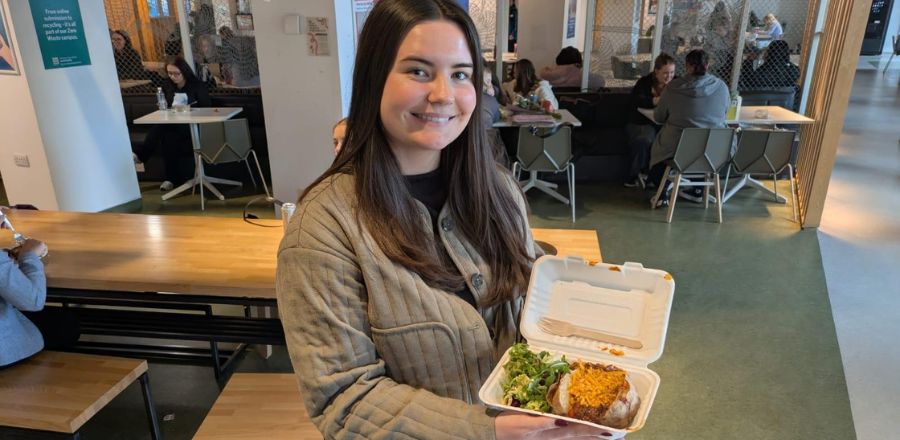
A student is passing on her nutritional knowledge to help the GCU community recognise the importance of a balanced diet.
Mirren Gregory is in the third year of her BSc (Hons) Human Nutrition & Dietetics degree and has enjoyed gaining an insight into the science of food and how we can support our bodies in the best possible way.
Whether you’re curious about how much protein is too much protein, the difference between carbs and fats, or even Mirren’s dream dessert, we’ve got you covered.
Where did your interest in nutrition come from?
“I knew from school that I wanted to work in healthcare. I initially actually studied nursing at GCU for a couple of years and just found it wasn’t the right fit for me; however, nutrition is actually spoken about quite a lot within nursing and I always found it really interesting.
“I had worked with a dietician during placement and I just assumed it was someone who helps a person lose weight. Learning from them about how nutrition can help prevent and treat a disease was just a real eye-opener. I then found the course and it has just been amazing – I’ve learned so much more than what I thought. It’s just been so interesting.”
How important is it for students to keep a healthy diet?
“Student life can be really stressful because we have so much going on, but it is so important to have a healthy, balanced diet. It impacts massively on your concentration levels and memory, so it really is important to think about it.
The link between food and wellbeing is massive. If we don’t provide our body with enough fuel then we’re going to be under-fuelled for the whole day and we won’t be able to retain information. Overeating has the same effect because our body doesn’t know what to do with all the excess energy and it can sometimes have the opposite effect.
Instead of our body using that energy to fuel us, it makes us feel sluggish. A lot of people describe if you have a big takeaway or a big meal, you often want to go for a sleep after that. It's because you've got too much energy - your body doesn't know how to utilise that. Caffeine is something that a lot of us have, and it improves our concentration levels. But again, that's something that can have the opposite effect and can cause spikes in anxiety and heart palpitations. Again, nutrition is something that is really individualised to each person, and there's no one-size-fits-all for everyone.
We all work part-time jobs as well, so it's so important to have a good, healthy, balanced diet because that helps set the foundations. Your diet directly impacts your concentration levels, your memory; your overall wellness, essentially.
It's so important to focus in on that without putting too much pressure on it. We don't want to create bad relationships with food or anything like that but it's just such an important part of your overall well-being. With a good, healthy diet; it's just really setting you up for success.”
Everyone has heard of the different food groups; carbohydrates, protein, fruit, vegetables, fats, etc. What are the importance of these food groups?
“Carbohydrates is our main energy source for our body, so our body plus carbohydrates is our preferred energy source. We're going to utilise that first because t's really important for our brain health and overall activity levels. That's going to be what fuels us for studying for an exam, walking to university, etc.
There's different types of carbohydrates you can get. Your starchy carbohydrates are your breads, your pastas, noodles, potatoes, and those kind of food groups. Then you also have your fruits and vegetables, which people don't normally associate with carbohydrates. I think when you say carbs, people think of bread but forget that fruit and vegetables are another source.
As well as your sweet treats, your chocolate and your jelly sweets, they have a carbohydrate source. Of course, when we're talking about carbohydrates, we're wanting to lean towards whole foods so that's why we do tend to not include the others.
We also have our proteins. Protein, I think, is something that's really big just now. Everyone's obsessed with high-protein diets but in reality, the average person only really needs 0.75 grams of protein per kilogramme of body weight. So that's looking at about 60 to 75 grams of protein per day just for the average person.
In the UK, we are exceeding that. There's never really an issue with maintaining our protein requirements. If you are someone that's a bit more active, maybe you're looking to go into a calorie deficit, a gym-user, or you're training for something, then there's definitely evidence to support that higher-protein diets are essential for the growth and repair of muscles and tissues.
Then, we have our fats. Again, fats do get quite a bad reputation. People see fats and think “I don't want that, it's got too much fat in it.” but we have different types of fats; saturated and unsaturated fats. You have probably heard of some foods having ‘good fats’ in it. Unsaturated is the kind of fat that we want to include more in our diet. You find those kind of fats from olive oil, peanut butter, avocadoes, etc.
Fats are really important in hormone production. It's really important to allow that to happen. It also allows different sorts of vitamins being able to be absorbed by our body, so we need a good amount of fat.”
What is your opinion towards ‘Traffic light’ labelling on food packaging?
“I think it's a difficult one because it's something that, so we advise our clients and patients to like look at these things, but people often see the red colour on the chart and worry that it’s too unhealthy.
On the other hand, nuts are so good. They're full of fibre and protein. Again, they are quite high in calories and fats, but it's the kind of good fats again that we need.
They're not your typical saturated fats that you're going to find in like fried crisps or like fatty chickpeas. It's the good fats but it really depends on your kind of goals when it comes to nutrition.”
‘Everything in moderation’ is this phrase something that dieticians agree with?
“I feel like ‘everything in moderation’ is the buzz phrase that you always hear, but it's because it is so true. It’s so important for so many different reasons, including making sure that there is variety in your diet as well.
You want to try and eat as many different foods as possible and feed your gut’s microbiome as many different nutrients as possible.
On the same hand, when we say everything in moderation, we do it because we don't want to instil any negative relationships with food. We don't want to say “You can never have chocolate ice cream again because it’s terrible!”
It can create poor mental health by restricting food and it becomes a whole different scenario. When we say everything in moderation, we do encourage allowing yourself to have sweets or snacks because I think sometimes we forget food is just so much more than fuel. It's not just something that we eat to stay alive.
In our society now, food is so much more. It's part of our cultures and social gatherings. Therefore, we also have to remember that and we can’t be too strict on ourselves.”
What do you think about the food options at GCU?
“I think it's fabulous. I wasn't aware that there were so many different kinds of outlets - it's great. The one that I go to most would be the Chapters Café in the library. I like a quick lunch, so having soup and a roll on offer is great for me in terms of quickness and being easy for me. I recently went to the George Moore restaurant and it's amazing what they have on offer.
There's so much variety and there's so many different outlets across campus, so you're never really waiting a queue for longer than a couple minutes, which is really good. They always go in quite fast and I feel like there's something for everyone there.
I'm glad that I went because I wouldn't have known how good it was until I'd tried something, but I'm impressed by it.”
Onto your own thoughts on food….tell us your favourite Starter, Main Course & Dessert!
“For a starter, I love a soup anywhere I go. I love a fresh tomato soup, with loads of croutons on it, some garlic, balsamic glaze, and then a bit of bread and butter on the side.
For my main course, I had this pasta in Italy one time and it was a pesto and pistachio pasta. It came with a pesto sauce with loads of pistachio pieces on top - it was unbelievable! I had that with some garlic read on the side.
For dessert, I would choose some sort of sticky toffee pudding with ice cream and some sort of like milkshake, like an Oreo milkshake!”
Find out more about the Human Nutrition and Dietetics programme on the GCU website
By Ross Clark
Achieved something related to your course or in your personal life? Email me at Ross.Clark@gcu.ac.uk