
Student’s research provides positive steps for the future
Trigger warning: this article discusses eating disorders and some of the health implications associated with the condition
A kind-hearted podiatry student has combined her resilient personality with her love of helping people to create a groundbreaking research project.
Heather Andrews completed the Carnegie Vocation Scholarship last summer, with her innovative two-part study focusing on the impact of eating disorders on the lower limb.
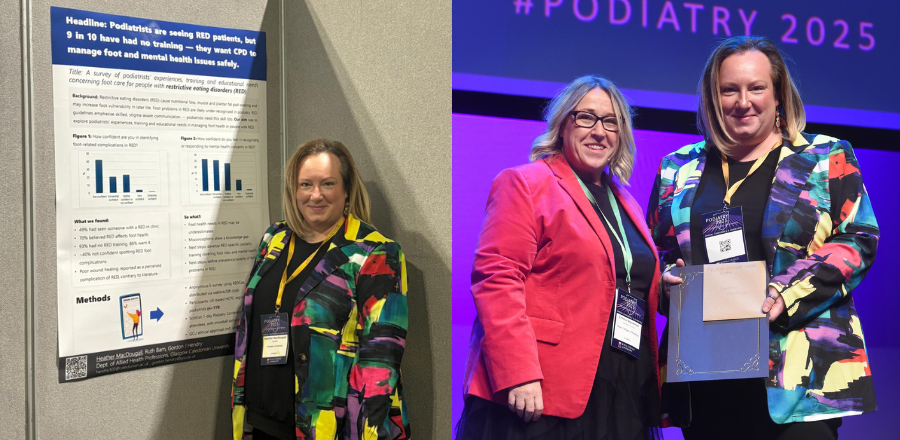
Her research went on to win the People’s Choice Award at the Royal College of Podiatry’s annual conference in November last year – quite the achievement for someone who didn’t ever expect to study at university.
“I left school with no qualifications at the age of 13,” explained Heather. “I was diagnosed with dyslexia as an adult and that helped me understand why I struggled at school, and that it wasn’t actually me that was the problem.
“Until very recently I had absolutely no real understanding of podiatry. I got an injury in my foot during lockdown and spoke to someone on the phone who told me it was plantar faciitis, but I knew it was something more serious. This led to me doing a lot of research and helped me understand that there was so much more to the lower limb than I initially thought. I eventually got to see someone in the second lockdown and it turned out I had actually ruptured my plantar fascia.
“When I spoke to the podiatrist, I found out that there was a real issue with mass retirement and not a lot of people coming into the profession. I realised I could find a way of getting to university and go down that route of becoming a podiatrist – I didn’t have anything to lose.”
Heather went on to complete an Access to Podiatry course which then allowed her to study at GCU. Since then she’s thrown herself into her studies and taken on the role of Class Rep and Department Rep, as well as becoming President of the GCU Podiatry Society. Despite all this, it was actually away from the classroom that Heather stumbled into a new area of her profession.
She explained: “I have a friend who has an eating disorder and she ended up in hospital after a relapse. She was dangerously underweight and I remember seeing her feet and thinking that they didn’t look like 19-year-olds feet. I had been on placement throughout my degree and they looked like the feet of someone who was very elderly.
“I began asking questions about this in class, particularly around the fat pads we have at the bottom of our feet. I didn’t think you could increase or decrease these like the fat elsewhere on our body, but I had noticed they were basically gone on my friend. Nobody had an answer for me as to why this was the case.”
Even Google couldn’t help Heather get any answers – so she decided to take matters into her own hands after her friend continued to suffer.
“She’s been in an incredible amount of pain and basically been constantly told that it will get better once her weight is restored, but that just hasn’t been the case. I’ve been helping her as best as I can, but this overall situation has led to me having more questions than answers.
“Eating disorders are obviously related to mental health but the impact it has on people mentally and physically is heart-breaking. As podiatrists, we might not be able to help them mentally, but pain is a big thing we should be able to support them with.”
Research was something Heather was interested in as a student but she didn’t view herself as a ‘natural’ due to her self-confessed lack of interest in reading.
“I knew it wasn’t my strong point and I also felt like there must have been some sort of study done on this that I was simply just missing.
“I’m part of the Glasgow Branch for the Royal College of Podiatry and a couple of people there had completed the Carnegie Scholarship and really encouraged me to do my own research."
After a further discussion with her lecturers, Dr Ruth Barn and Dr Gordon Hendry, Heather decided to apply and eventually got permission to start her research journey.
She said: “The first part of the study focused on the effect restrictive eating disorders has on the lower limbs, and the second part looked at podiatrists’ perception and understanding of those effects.
“My sister-in-law works with an eating disorder charity so I was able to access patients through that. My involvement with the Glasgow Branch of the Royal College of Podiatrists meant I helped organise the Scottish one-day conference in May last year. This allowed me access to a large number of podiatrists. Both of these links meant I had the perfect combination to gather the evidence for my research.”
“The key thing that stood out from the results was that everyone with eating disorders had the same sort of issues when it came to their feet. Podiatrists perception of people with eating disorders were that they would look anorexic and that there wouldn’t be any issues when an individual was in the process of getting better – this mirrored my friend’s personal situation.”
Heather wanted to take her research to a bigger audience and decided to create her own poster and highlight her findings at the Royal College of Podiatry 2025 Annual Conference and Exhibition.
She explained: “A lot of the podiatrists who got involved in my research were keen to find out the results. I realised that the Royal College of Podiatry 2025 Annual Conference and Exhibition was coming up in November. Part of the conference involves poster presentations and I was given the opportunity to present my findings to guests at the event.
“There were about 25 other posters, with the majority of them created by PhD students, so I didn’t think there was any chance of actually winning best poster. I was more worried about just getting the information across in the best way possible, rather than it looking really fancy.
“I couldn’t believe it when I then found out that I had won – I just didn’t expect it. I think I was particularly surprised because I don’t view myself as a researcher and I also wasn’t thinking for a minute that anyone would actually vote for it.
“I would say the main feeling was probably imposter syndrome, but I was also very proud. I felt a little bit awkward about it all because I’m a student and I was highlighting this area that podiatrists didn’t know much about, but everyone has been so lovely about it.”
Despite the accolade of winning the award at the conference, Heather admits that there was far greater meaning in bringing the overall issue to the attention of her profession.
“The whole point of getting involved in podiatry was to help people. I’m ultimately lucky to have someone in my life who brought this issue to my attention and who had the ability to help me understand the sensitivity of the challenges she faced.
“The individuals impacted by eating disorders are at the heart of this research and I always wanted to ensure that everything within this study was done in a way that they were comfortable with. It was an incredible experience for me to get involved in the ethical side of the research and to have an insight into how all of that worked.”
Heather is now in the process of trying to get her research published, all while balancing life as a final year student.
“It’s obviously become a lot bigger than I intended. I’m proud to have received recognition for my work, but what’s important to me is that we continue to gain the knowledge to help people suffering from eating disorders.
“I’m now in the situation where I might consider doing this as a PhD but I’ve also been offered a job in Australia once I’ve qualified, so there are certainly options there for me. I never expected to be a researcher or anything like that, but I have always just went with where life has taken me. For now, I’m just focused on getting through fourth year and closing off this amazing chapter.”
There have been many ups and downs for Heather throughout previous chapters of her journey, most notably in November last year.
“My dad actually passed away suddenly just before the conference,” explained Heather.
“He was taken into hospital and then diagnosed with pancreatic cancer. He passed away just eight days later. I missed four out the first seven weeks of term at the start of the academic year and it was obviously a very difficult time for me.
“My dad was very proud of the fact I had continuously pushed for this study to happen. He said plenty of times that I’m like a dog with a bone – and that if I have a question then I need to find the answer.
“It’s been bittersweet having the success of the study because I know how chuffed he would have been to hear that I had won that award. I’m now just focused on continuing to develop myself and to continue making him proud.”
Find out more about studying Podiatry at GCU
By Ross Clark
Achieved something related to your course or in your personal life? Email me at Ross.Clark@gcu.ac.uk