Student’s research on AI lands award at conference
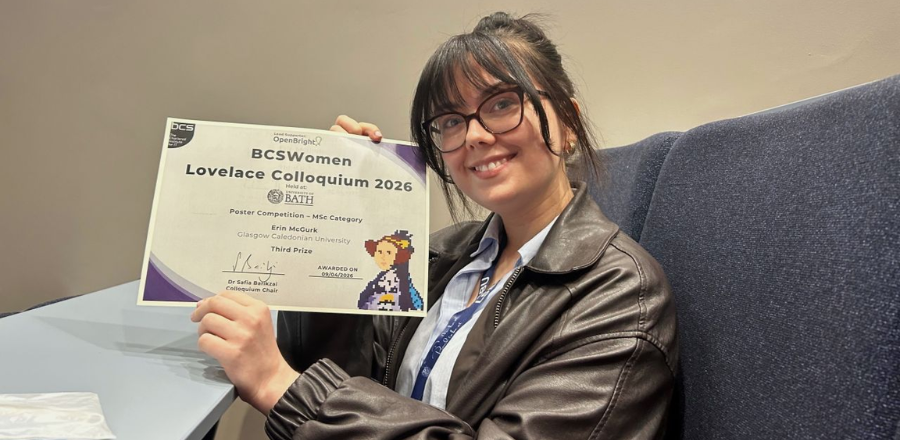
A GCU student’s first-ever research poster has led to special recognition at an annual conference.
Erin McGurk, who is studying MSc User Experience and Interaction Design, travelled to Bath in April for the BCSWomen Lovelace Colloquium to present her research: Reducing Cognitive Load in Financial Interfaces with Agentic AI.
The two-day conference brings together women and non-binary students of Computing related subjects. Erin was attending for the first time and managed to finish in the top three for her poster highlighting her work.
We caught up with Erin to hear all about her experience:
How did you come to study MSc User Experience and Interaction Design?
“I actually studied an Undergraduate degree in Media and Communication at GCU. My sister has her own creative design agency and I found the work she did really cool, so I got involved in that and my interest grew with that side of things.
“I considered just going into work after my degree but I managed to get a Data Lab Scholarship which meant I could get funding to complete my Masters – it really was a no-brainer.”
Tell me about the conference and why you got involved?
“My lecturer Laura Pruszko posted about the competition on Blackboard and mentioned it was for women and non-binary people. I submitted a 250-word abstract for my work on how agentic AI can reduce cognitive load in financial interfaces.
“I think what inspired me to look at this as a topic is the fact I want to work in fintech (Financial Technology) in the future.
“I was interested in seeing if there was anything with AI that could actually help people – I don’t want it to just be associated with taking people’s jobs away. AI is a topic that is constantly evolving and changing, so something I read last month could be out of date now. I think that’s what makes it such an exciting topic.”
What did your research look at and highlight?
“The original brief was to try and encourage younger people into investing. I figured if someone didn’t know much about investing then they’re not going to do it, so I wanted to use AI to help simplify the language often used on banking apps.
“The AI system I created detects hesitation when reading content and then provides simplified explanations. This means more people have a clearer understanding, which could lead to them becoming interested in investing.
“It can provide other words, a graph or more information to help people understand what’s being asked of them.
“It’s a simple idea, but very effective. I carried out user testing in my class and tried it with 30 people. My results showed that there was a 30% reduction in task completion time, so I knew it was good research to use for my poster. A few weeks after submitting my abstract, I heard that they wanted me to come and show my poster down in Bath.”
What was it like travelling down to Bath knowing you were going to an event like this?
“I was definitely excited. I just got a flight down because I was given a travel bursary. My sister and my mum came with me and we got a hotel in Bath. We had a nice couple of nights together.
“The conference itself was a great experience. I did feel a bit out of my depth because people there were like computer scientists and engineers, and I was there with an arts degree.
“There were three female speaker who spoke about coming up in the industry as a woman and the importance of keeping true to yourself and the work you do. There were people from different universities and organisations that focus specifically on supporting women in tech.”
What was it like to actually show off your work to all the attendees?
“It’s been done in different ways over previous years. Last year you physically stood with your poster and presented, which I wouldn’t have liked. This year they had decided before the event who they were giving awards too, having already analysed the posters ahead of the event.
“They actually told me that they had never had a GCU student finish in the top three before, so I felt really proud of that. There were about 200 or 300 posters in total, so to finish in the top three was just amazing – I didn’t expect it.”
Has the overall experience built your confidence?
“It definitely took away that sense of feeling out of my depth. I was talking to people there who had studied Computing Science Masters and they were saying how much they loved my idea, so I definitely felt good about myself. Every person I met was so lovely, so it was a really positive experience overall. It’s a situation I could never have seen myself in a few years ago.”
Find out more about the MSc User Experience and Interaction Design programme at GCU