Students provide historical insight with brand new game
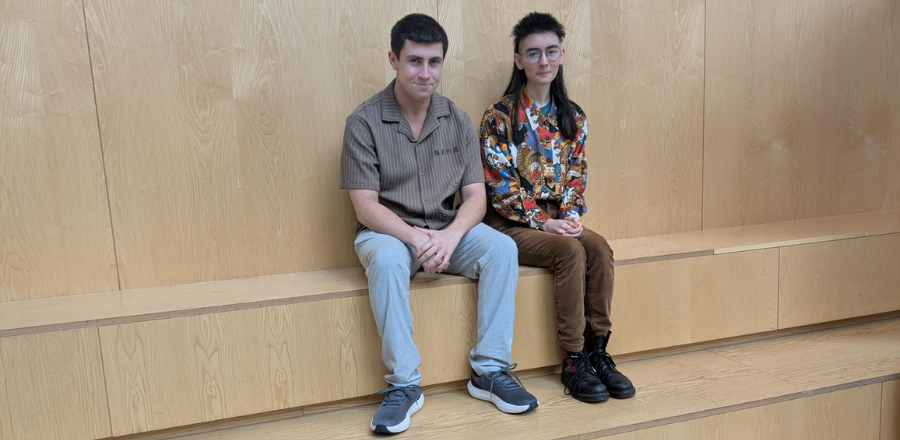
Two GCU students have helped bring a holocaust survivor's story to life through an interactive game.
Aiden Struthers and Akira Park-Hagiwara combined history and creativity to develop Suzanne, a ‘platform puzzler’ which tells the real-life story of Suzanne Ullman, a young Jewish girl living in Budapest during WWII.
The BSc (Hons) Games Development students worked in collaboration with the charity Gathering The Voices, which collects testimonies from holocaust survivors who lived in Scotland.
Aiden and Akira were invited to present their game at Caledonian Creates, an annual on-campus event highlighting the work of final year students from creative programmes across GCU.
We caught up with Aiden and Akira to find out more:
The Brief
Akira: “Myself and Aiden worked on the project together at the end of third year along with some of our other classmates. It was part of our module ‘Integrated Project 3’, which involves us working with external stakeholders to create a project based on a specific brief.
“There were different choices available to us, but we really liked the idea of working with Gathering The Voices. We were basically tasked with converting Suzanne’s story into a game which could encourage younger people to learn more about the holocaust.”
Aiden: “We basically created an interactive puzzle platformer reflecting the experiences of Suzanne Ullman in Budapest during the holocaust. We picked different parts of Suzanne’s audio testimony to include in the game.
“We had to go about it carefully because we didn’t have as much creative freedom as we maybe initially thought we did. We wanted it to be respectful and had to do our research before actually creating the different levels of the game.”
Suzanne’s Story
Akira: “It was fascinating to hear all about Suzanne’s journey - listening to her testimony really brought what she went through to life.
“Suzanne was a young, Jewish girl who grew up during the second World War. She originally lived in a house in Budapest in one of the city’s famous streets. During the War, there was an increase in antisemitism by the Arrow Cross, who were the far right, fascist political party in Hungary that worked alongside the Nazis.
“They brought in a lot of different restrictions against Jewish people and Jewish life. Jewish people were only allowed to live in specific houses and a number of Jewish families moved into the house Suzanne and her brothers were living in at the time. Because her house was in quite a prominent part of the city, she was eventually forced to leave and moved to another area, where conditions were very cramped and uncomfortable.
“She stayed in an old hospital for six weeks under the guard of German soldiers. Eventually a family friend, who had Christian papers, came to collect her and took her and her two brothers to a house, which belonged to a Swedish Diplomat living in Budapest, Raoul Wallenberg. He famously saved a lot of Jews by keeping them in houses that he was able to claim as Swedish territory. Sweden was a neutral country during the war, so this meant Suzanne and her brothers avoided being moved to a ghetto or concentration camp.
“After Suzanne and her brothers spent time in the house, the Germans and the Soviets began to fight in Budapest. The house was bombed, but she managed to flee to the cellar. Suzanne and her brothers stayed there for six weeks and were forced to eat snow after the water supply was poisoned.
“After the Russians seized the city, Suzanne was separated from her brothers and sent to an orphanage. She was eventually reunited with her grandmother and brothers, but it was when the Soviets were starting their communist regime in Budapest. They weren’t any use to them as they were too young and their grandmother was too old, so they were able to emigrate to the UK and were then reunited with their parents.”
Creating the game
Aiden: “There was obviously a really interesting historical side to Suzanne’s story, so we really tried to strike the balance between that and an interactive game. We wanted to authentically tell the story and realised how sensitive a subject it was.
“We created different levels which really highlighted the journey she went on throughout that time. It definitely meant a lot to us both that this was such a meaningful project and that it was being used by the charity.”
Caledonian Creates
Aiden: “Caledonian Creates is basically an annual event on campus that allows us to showcase our work and present our games to an audience.
“It actually gave us the chance to show multiple projects that we’ve been working on over our time here. The main focus was on Suzanne’s game and we had people coming round to hear about our game and how it reflected Suzanne’s story. They could even play the different levels, which really showed her experience during the war, including the difficult conditions she had to live in.
“We also had the honour of meeting the Principal, Professor Mairi Watson. It was a privilege and felt a bit surreal to hear she was actually interested in what we had made.
“It meant a lot to me because I didn’t think there would be much interest in the games I made when I went to the event. There were a lot of other games within our year that I thought would have been much more popular, but I think the fact our game was about human experience may have actually really helped drive interest.”
Overall experience
Akira: “Caledonian Creates was a great experience because it gave us the chance to actually present what we’ve been working on, which is something that will be expected of us within the gaming industry.
“Creating the actual game is also fantastic for our CVs at this point in our career. Most games are created for fun and entertainment, but I liked the fact we were able to create something a little different that can be used to help educate young people.”
Aiden: “I think the experience of working on all aspects of the game has really helped improve me as a professional. I might call myself a ‘programmer’ but this project has allowed me to work on a lot of level design and animation, which is stuff that I wouldn’t normally do.
“I feel I’ve really developed a lot of transferable skills. I’ve also met a lot of people through this project as well, and I’ve really seen the benefits of networking in-person and through LinkedIn.”
Find out more about Suzanne’s story and play the game via the Gathering The Voice website
By Ross Clark
Currently studying at GCU and achieved something related to your course or in your personal life? Email me at Ross.Clark@gcu.ac.uk