
Seaweed epiphany leads student down new career route
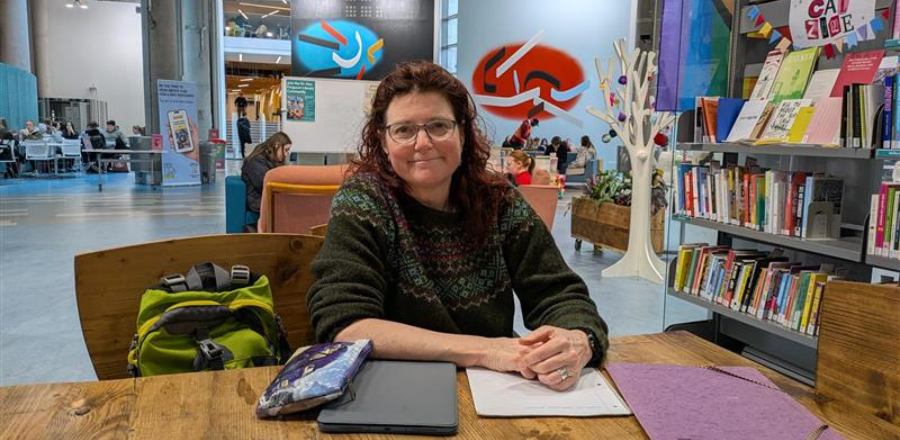
A Food Science student has been reflecting on her love of seaweed and how it’s helping shape her future career.
Penny Crisp has lived in Scotland for a number of years after emigrating from Australia, with her new home offering a lifestyle change in more ways than one.
She explained: “I worked as a props maker in the film industry in Australia and it made me really ill with irreversible lung damage. Instead of going into another area of that industry, I decided science was the new route I wanted to go down.
“I went to college in Greenock and started studying Applied Science at Level 5. Dr Janice Taylor, who runs the Food Science programme, spoke to my class at college and told us about the course. It ticked all the boxes as there are just so many options for me through it.
“By that time I had actually came to the realisation that seaweed was my interest. I had went through a bit of a transition and made the decision to give up alcohol. I needed something to replace ‘the crazy’ and I started wild swimming at Loch Fyne. I had an epiphany moment when I was swimming around and looking at the seaweed.
“I started researching it in more detail online and learned about all the marvelous things it can do and be. I learned that the Seaweed polysaccharides are really useful, which is especially important given creating alternative plastics is one of the main drives for the food industry.”
Penny, who has also been a member of Greenpeace for 30 years, developed a further interest when she learned about the impact seaweed can have on us as humans.
She said: “We hear all about seaweed in terms of food now, but there is far more to it than just that - it produces over 50% of the oxygen on the planet. That’s a fact that definitely shocks many people but you just need to think about how much water there is on the planet. It makes sense that photosynthetic aquatic organisms are going to produce a huge amount. It just shows that protecting that will protect our oxygen.
“We’re currently pouring more and more acid rain into the ocean and microorganisms outer membranes can’t cope with that acidic environment. When seaweed photosynthesis it actually cleanses the ocean of the acid, so it basically cleans it up human pollution. The more we have the better; it’s the base of the food chain and it’s an ecosystem for the sea. There’s also a lot of research being carried out now into seaweed and it’s anti-cancer, anti-diabetes and anti-Alzheimer’s properties.”
Having now been a member of Scottish Seaweed Industry Association (SSIA) for several years, Penny is always keen to hear about the latest developments within the sector and was delighted when she received an invite to London for the official unveiling of the UK Seaweed Network.
“It was hugely exciting and I couldn’t really believe I was going to a parliamentary reception at the House of Commons,” explained Penny.
“The key for me was that this was the unification of devolved nations around seaweed – I just thought that was really cool because we live in a time where there is so much disagreement between countries.
“Ireland are actually way ahead of all the other countries in the UK because they wild harvest a huge amount of seaweed, whereas in Scotland we focus more on farming. Asia produces 98% of the world’s farm seaweed, so we’re competing with a market that is very well established. Our new product in seaweed farming is too expensive to go up against that, so we need the government to subsidise it so that it becomes more marketable. The launch of UK Seaweed will be so important in closing the gap to Asia.
Penny added: “The event itself was great and it was really nice to meet other people from the industry. There were a couple of different presentations and then a Q&A session with the people who basically created the UK Seaweed Network. We then had the opportunity to do some networking. I think if I looked 20 or 21 then it might have been harder for me to talk to people, but I have the benefit of being a mature student.”
Despite graduation being just around the corner Penny has been preparing to take her passion to a new audience.
“I’m actually now writing a thesis on seaweed and I’ve created a seaweed infographic sculpture. I showed it to people at the conference and everyone was really excited because there isn’t that much educational information out there about seaweed.
“The sculpture has QR codes on it which provide information about the uses that humans have for seaweed; things like alternative plastics, nutrition and biopharmaceuticals.
“I’m also now a STEM Ambassador and I’ll be taking my sculpture out on the road with me to teach young people about the importance of seaweed. I’ve been reaching out to existing seaweed industry experts within Scotland and my plan is to try and go to primary schools that are near those organisations. Going forward it will also be introduced to higher education and industry. We can’t have a seaweed industry if we don’t have people interested in it.”
Do you work in a primary school or know someone that does? If you want a visit from Penny and her innovative seaweed sculpture (between 10th March and 15th April this year) then please contact pennynotpolly@icloud.com
By Ross Clark
Achieved something related to your course or in your personal life? Email me at Ross.Clark@gcu.ac.uk