DPsych Counselling Psychologist developing personally and professionally at GCU
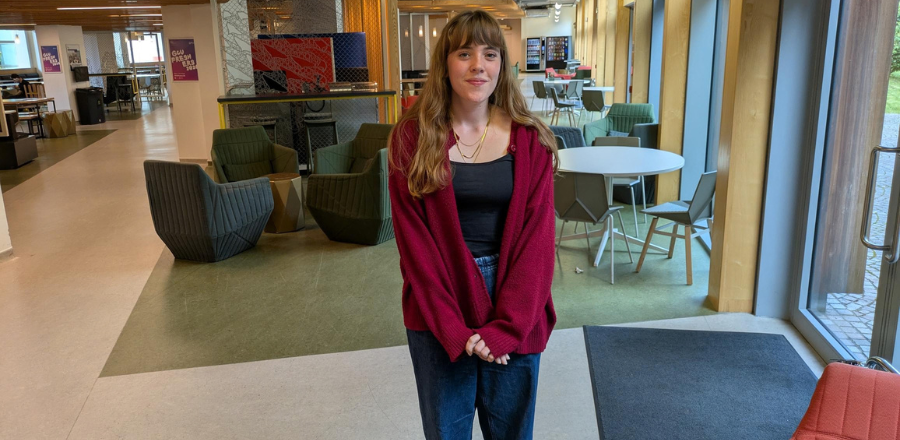
A trainee counselling psychologist has reflected on her growing confidence after having her research published for the first time.
Orla Troup teamed up with Dr Bryan McCann for a qualitative study into the barriers to self-initiated exercise in trauma recovery. The systematic review was the first step in the process, with the hard work continuing for Orla as she looks to develop the research field with her very own major study, which highlights the challenges faced by individuals from a variety of different backgrounds.
Despite her success, Orla insists it’s been quite the journey to this point in her career.
“I actually didn’t really know what I wanted to do when I was growing up,” explained Orla.
“One thing I did know was that I really wanted to help people, and that led me to a crash course in psychology at school. I enjoyed it and decided to go on and complete an Undergraduate degree in Psychology at the University of Glasgow.
“It was only during my course that I found out what Counselling Psychology actually involved. I didn’t want to just be a counsellor or just be a psychologist, so hearing that Counselling Psychology was actually a thing was just perfect – it felt like it had been invented for me.”
Early research partnership
Orla quickly formed a partnership with Dr Bryan McCann in the early stages of her Doctorate, allowing her to explore her first area of research.
“I was paired with Dr Bryan McCann in first year and it was interesting because he’s more focused on sport than I am. What we did both have, however, was a shared interest in trauma, and that really got us thinking about combining our knowledge. Once we narrowed down that we’d be interested in the role self-initiated exercise can have in trauma recovery, we set up the project and systematic review.”
Orla used the research skills she’d developed throughout her time in higher education to research the topic and create the systematic review alongside Dr Bryan McCann.
The purpose of the research is set out in the study’s Abstract: “There is substantial quantitative evidence in support of exercise as beneficial for trauma recovery, particularly in targeting the neurobiological mechanisms disrupted by trauma. It is therefore important to understand the circumstances under which individuals may avoid exercise, ultimately preventing them from accessing the wellbeing benefits.”
Orla said: “I focused on qualitative papers and what stops participants from exercising during recovery. I wanted to bring all the research together and see what the common thread was.
“The main things that were coming up were around people feeling safe in different ways, for example safety in their environment, safety internally and social safety. If they didn’t have safety in any of those areas then that would stop them from exercising.
“Another factor was that their trauma symptoms would stop them from exercising. If they felt dissociated, for example, then they wouldn’t be able to engage in exercise because it could force them back into their body when they didn’t want to do that.
“The third key finding was that different costs in exercise recovery could lead to them stopping exercising. They may have wanted to spend money on exercise but also have to pay for therapy, so they then had to weigh up what was more important. If they realised it was therapy, or if the cost on their body was too much, then they wouldn’t exercise.”
Orla added: “The main takeaway for me is just being mindful of the fact that there will be people all around us that are using exercise to cope with trauma. It’s important to think about how we can accommodate them a little better. For example, if someone’s in the gym and throwing weights down onto the floor then that can be really distressing to someone who’s been through trauma, even though it may seem like nothing to you or I.”
Becoming published
Despite reading countless papers and carrying out hours of research, Orla admits she was still shocked when she first realised her work was going to be published.
“It’s so strange seeing my name underneath a study! I’ve read so many journal articles throughout my two years on the Doctorate and four years on the Undergraduate, so to actually think ‘oh wait, that’s me’ is definitely a feeling I’ve never had before.
“Bryan had said at the start that I should try and get my work published, and I automatically just thought there was no chance of it happening. It was a real surprise when it got to that point - I was just absolutely delighted.”
From quantitative to qualitative
While completing the systematic review, Orla recognised that there was more work that could be done around her chosen topic. She further developed her research on self-initiated exercise through a qualitative study, which involved her interviewing seven participants.
She explained: “When I was looking at all the different papers, I really found that qualitative research would be very useful to explore the topic further because trauma can impact everyone so differently. The best way to explore that was by actually talking to them.
“This resulted in me interviewing seven participants who were different ages, and they all spoke about what exercise in general means to them in terms of their trauma recovery. I found it really interesting because it allowed them to reflect on things like gardening and even the impact of just walking to work.”
Orla added: “It was a little daunting because this was my first main qualitative study at Doctorate level, so I didn’t really feel like I’d had a practice run with it. Half of the Doctorate involves counselling individuals and half of it involves carrying out research; however, counselling someone one-on-one is very different to interviewing someone for research. Thankfully, it all went fine and I’ve learned a lot from it that I can take into the future.”
Further research
The qualitative and quantitative research Orla carried out has again opened up other avenues for further exploration in the future.
She said: “One of the things that was noticeable to me when I was interviewing people was that they mentioned having a traumatic event and how at one point it even stopped them from leaving the house. Obviously a big change must happen from being at that point to the stage where they are sitting with me and talking openly about it.
“My hope is that over time I’ll be able to dig a little deeper and develop an understanding around the facilitators and barriers to recovery and the role self-initiated exercise can play.”
The future
On a personal level, Orla is both excited and nervous for what the future holds in a professional capacity.
“This time next year I won’t be able to call myself a trainee, which is a little scary! I do know that I would love to be able to keep research as part of my life. In an ideal world I would like to work alongside other people who are separate to the world of psychology; for example physios, personal trainers and gym staff. Using our training back and forth would be beneficial because they might not know what to do when someone is expressing mental health problems, but then psychologists don’t know what to do with building exercise into people’s lives. I really want to help bridge that gap.”
As well as developing her research skills, Orla also reflected on the personal growth she’s experienced throughout her time at GCU.
She explained: “A major bonus throughout my time as a trainee is that I’m gradually beginning to believe in myself a bit more. I’m slowly becoming more confident, which has been an issue throughout my life.
“I have to credit Bryan with helping me in that regard, he’s been incredibly supportive and made sure I continue to push myself. He’s also been great at making sure I take time away from my research. I’m the sort of person if I had any free time then I would definitely just spend it doing more work. It’s important for me to practice what I preach and make sure I’m looking after myself.”
You can read Overcoming the hurdles: A systematic review of barriers to self-initiated exercise in trauma recovery here
You can also find out more about the DPsych Counselling Psychology course here