An honest conversation for Transgender Awareness Week
"My identity is not a political statement. I just want to be seen as a woman."
Taking place from Friday 13 to Thursday 19 November this year, Transgender Awareness Week is an opportunity to celebrate the transgender community and encourage greater understanding and acceptance.
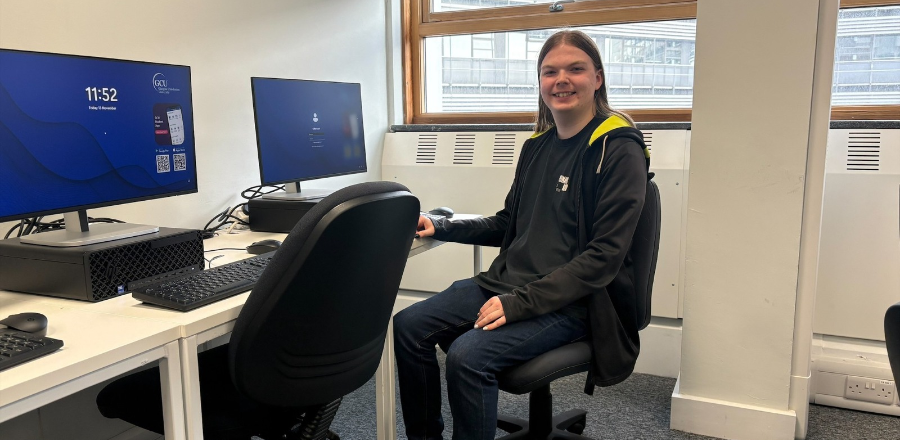
We spoke with Molly, a fourth-year Multimedia Journalism student, about her experiences and highlight why awareness and inclusivity matter.
By sharing her story, we hope to challenge misconceptions about the trans community and remind everyone that being accepted for who you are should never be too much to ask.
Q. So, what has your experience been in education as someone who is trans?
"There were always signs, but I didn't really realise and start coming out to people until 5th year of secondary school. At that point, I just came out to my friends, and I figured I'd spare myself the harassment and the hassle, so I just didn't tell anyone else at school.
"When I got to college, I just introduced myself as my new name and went from there. I've not really had any 'bad' experiences really. I emailed at the start of my course to change my name on the system, my ID and some sections of my skills profile say Molly, some don't. So aside from having my dead name shouted out a few times when taking attendance by accident, it's not really been as issue."
Q. What are some of the challenges have you faced because of your identity?
"Being trans is both something you're discriminated for, but it's also a condition. It's like depression in a way where a lot of the time I feel fine, but sometimes I'll have really bad dysphoria days where I'm feeling quite awful and I don't want to be perceived by anyone.
"Then there's the harassment. I get the stink eye a lot in public, and I can see how people's eyes go from surprised to almost disgust as I walk past. Then there's the more subtle stuff, especially when I'm at work and I'll either have makeup on or my pronoun badge on.
"Some people seem to take it as a personal challenge to misgender me as much as they can to my face because they know if I say something they'll just be like oh sorry, I didn't notice. A lot of transphobias is people doing what they think they can get away with because they know if I push back, they have an excuse for it."
Q. Do you feel that educational environments overall are inclusive and supportive?
"I guess I would. I don't feel like there's exactly any resources or anything available for me as a trans person, but they're doing what they're required to. The option to change my name is there and no one's actively misgendering me, so at least there's something being done."
Q. Why do you think transgender awareness week is important?
"It's important because I don't think cisgender people really think about us. For a lot of people I know, I'm the only trans person they know. I don't mind speaking on it, but I do find it funny when anyone needs to speak to a trans person, they think of me.
"I don't want to point fingers and say cisgender people are privileged, but they don't really need to think about how people see them. I suppose everyone has that to a certain extent though because as a white woman I don't have the same struggles that a black woman would have. I think it's good that there's something that will at least encourage people to think about what it's like for us."
Q. What can other students do to make trans people feel more included?
"I suppose, not to sound preachy, but educating themselves better. A lot of cisgender people are fairly clueless when it comes to trans people. Most do really mean well, but sometimes it can come off a little offensive. I think the problem with a lot of trans people is that the goal is to pass and be gendered correctly by default.
"People can't read my mind, so it's not their fault if they interpret me wrong. If you've got any specific questions, I'm sure most of us would be happy to gently, but firmly, explain."
Q. What is one misconception about trans people that you wish more people understood?
"First of all, we're not these dangerous predators that some people like to portray us as. I feel like a lot of well-meaning, but uneducated, allies don't see us as 'real' women or 'real' men. They think they're accepting us by saying "break gender norms, you don't have to conform", but I don't want to be breaking gender norms and sticking it to the man.
"My identity is not a political statement. I just want to be seen as a woman. I suppose the misconception is that some people think we're rebelling when a lot of us want to, for lack of a better term, just assimilate, and being seen as who we are and not some in-between thing that some people view us as."
Q. What message would you like to share with people during transgender awareness week?
"Just be nice to your local trans person, we could all really use it. It's very easy as a trans person to feel like everyone hates you. Everyone's looking at you, and everyone's against you.
"I think people should be able to do whatever they want. Just be nice to your local trans people."
Behind every identity is a personal story, filled with experiences, challenges and moments of self-discovery that deserve to be heard.
Listen, learn, and speak up.
Use your voice to create change as acceptance shouldn't be limited to one week of the year, it should be something we show every day.
By Olivia Bowen