
International conference highlights precision engineering's role in sustainable future
Researchers and engineers from around the world gathered at Glasgow Caledonian University this week for a conference exploring how precision engineering can support the transition to a more sustainable future.
The euspen Special Interest Conference on Precision Engineering for Sustainability took place at the University's Glasgow campus on 2 and 3 September, bringing together experts from academia and industry to discuss topics including renewable energy, energy storage, the circular economy, net-zero manufacturing and sustainable production.
The conference showcased research from Glasgow Caledonian alongside contributions from institutions across the globe, highlighting the growing role of precision engineering in addressing sustainability challenges.
The event was opened by Glasgow Caledonian University Principal and Vice-Chancellor Professor Mairi Watson, who welcomed delegates before Professor Emad Farrag, Professor of Electrical Power Engineering at the University, delivered the opening keynote address.
Professor Farrag explored the potential of small-scale renewable energy systems, including solar photovoltaics, small wind turbines and community energy storage, to support sustainable and resilient communities. His presentation examined how locally generated renewable energy can reduce carbon emissions, improve energy access and deliver economic benefits, while emphasising the importance of community participation, innovative financing and supportive leadership in the transition to cleaner energy systems.
A number of Glasgow Caledonian researchers also presented their work during the two-day conference.
Dr Richard Danyi discussed battery energy storage for a low-speed vertical axis wind turbine in a rural community, while Godwin Enemalii presented research into the use of edge artificial intelligence to detect defects in wind turbine blades.
Professor Babakalli Alkali explored predictive maintenance for wind turbines, and Dr Ahmed Solyman presented research on secure Internet of Things architecture for wind turbine condition monitoring, as well as a low-cost unmanned aerial vehicle framework for inspecting wind turbine structures.
Dr Juan Manuel Parrilla Gutierrez also shared research into 3D-printed structural and aerodynamic components for unmanned aerial vehicles.
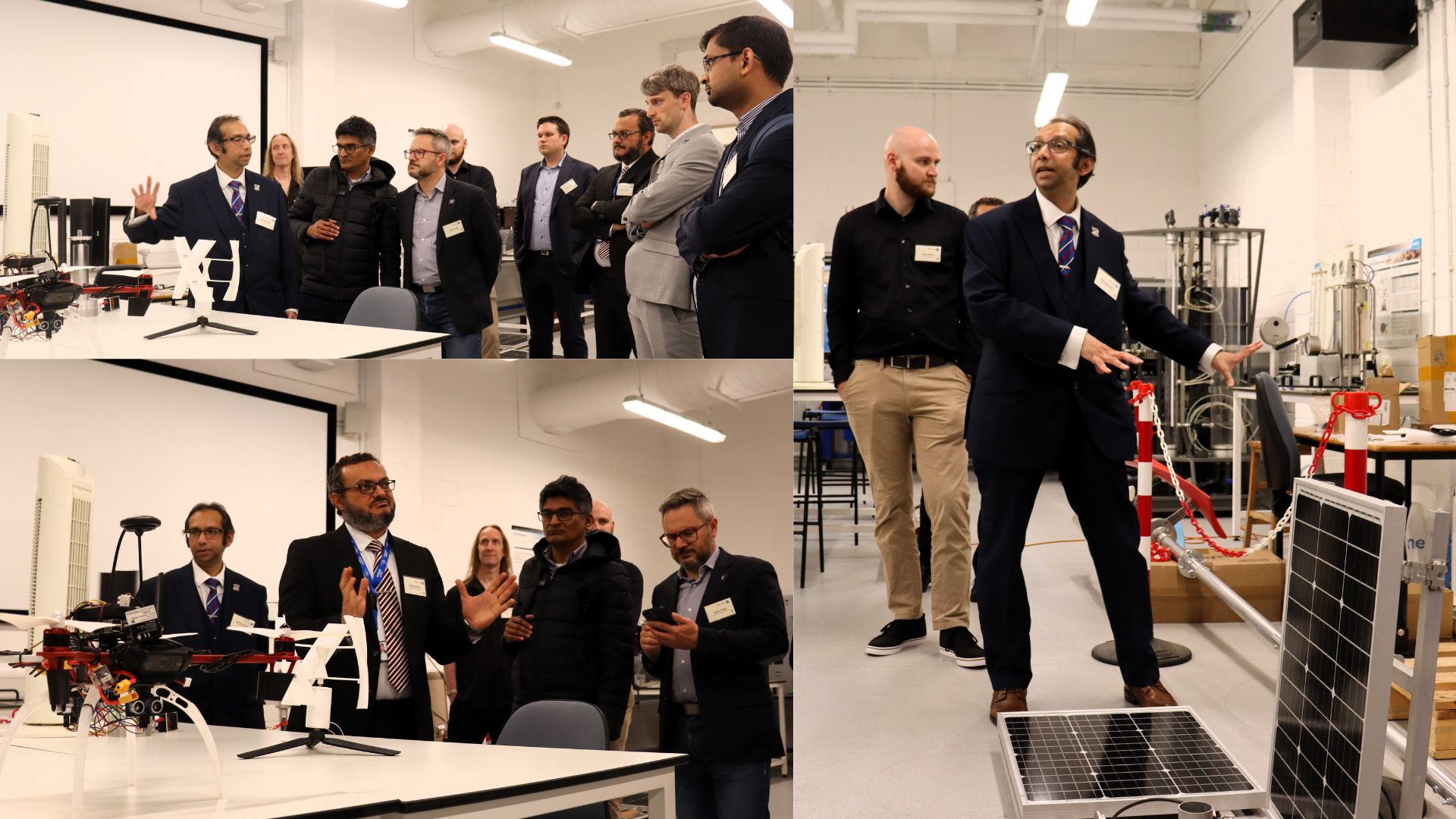
Delegates were also given the opportunity to tour Glasgow Caledonian's laboratories, providing a first-hand look at the University's facilities and research activity (pictured).
The international keynote programme featured Professor Alexander Slocum of the Massachusetts Institute of Technology (MIT), who spoke about creating a new standard for rapid-swap battery interfaces.
Professor Slocum, a leading figure in precision engineering and mechanical design, has published more than 150 papers and holds more than 116 patents. His work has contributed to products recognised with 11 R&D 100 Awards.
Additional keynote presentations were delivered by Professor Ali Gökhan Demir of Politecnico di Milano, who discussed laser manufacturing for electric vehicles, and Professor Tim C. McAloone of the Technical University of Denmark, who explored the potential of remanufacturing in supporting the sustainability transition.
The conference was organised by the European Society for Precision Engineering and Nanotechnology (euspen), which promotes the role of precision engineering in developing the technologies and manufacturing systems needed to support a global low-carbon economy.
Dr Mahmood Anwar, who chaired conference sessions and served on the organising committee, said: “The event provided an excellent opportunity to highlight the breadth of sustainability-focused research taking place at Glasgow Caledonian alongside work from our international partners. The quality of discussions and level of engagement throughout the conference demonstrated the important role precision engineering can play in delivering sustainable solutions for the future.”