
GCU research highlights how AI could help power a greener future
Researchers at Glasgow Caledonian University have contributed to an international systematic review examining how generative artificial intelligence could support cleaner, more reliable and secure energy systems.
The paper was published open access in Artificial Intelligence Review, a Springer Nature journal, and examines how generative AI tools are being developed and applied across renewable energy and smart electricity networks.
As countries work towards net-zero targets, energy providers face growing challenges in managing renewable sources such as wind and solar power. Their output varies with weather conditions, increasing the importance of accurate forecasting, effective network management and resilience to disruption.
The review found that generative AI methods are being explored for applications including renewable-energy forecasting, generating scenarios to help energy planners prepare for different conditions, electricity-network planning, operational decision-making, asset management and cybersecurity.
However, the authors emphasise that generative AI should complement, rather than replace, established engineering models, physical simulations and expert decision-making. They also identify a need for stronger testing, real-world validation, human oversight and responsible governance before these technologies are deployed in critical energy infrastructure.
The study brings together 15 researchers from 11 organisations across seven countries: the UK, Norway, Japan, Estonia, Sweden, the United States and the United Arab Emirates. Glasgow Caledonian was one of three UK universities involved, alongside the University of Glasgow and the University of York.
The GCU authors are Ibrahim Kucukdemiral and Yashar Mousavi from the Department of Engineering.
The literature search identified 1,402 studies published between 2020 and 2025. After screening titles, abstracts and keywords, 349 studies remained, with 106 selected for detailed analysis.
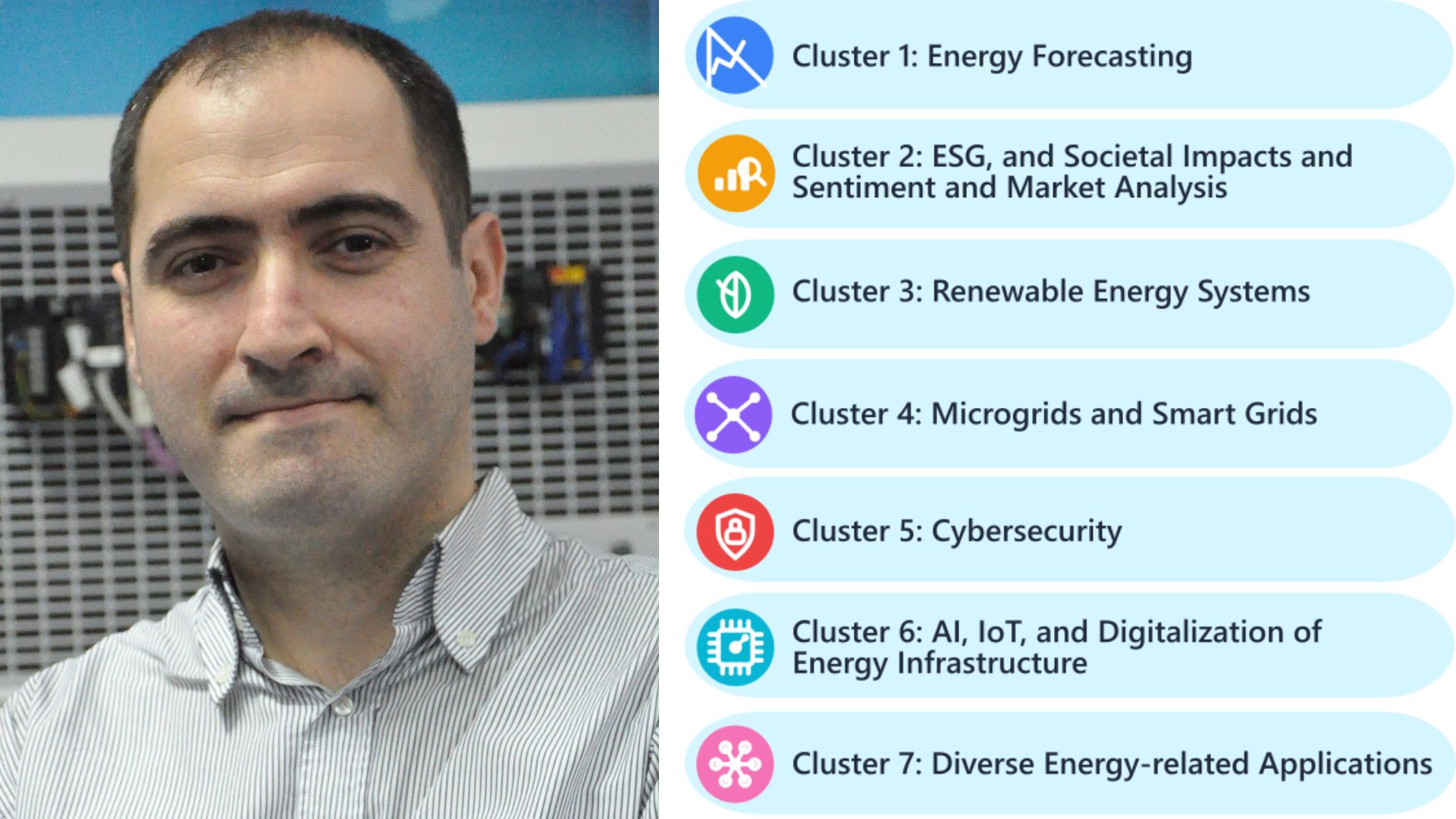
The researchers organised the evidence into seven areas covering forecasting, energy-system design and network planning, operation and control, reliability and asset management, data and cybersecurity, energy markets, and wider social and technical applications.
They also developed a framework showing how AI applications could interact with different parts of the energy system, from physical infrastructure and data to network operations, energy markets and regulation.
Yashar Mousavi completed his PhD research at Glasgow Caledonian under the supervision of Ibrahim and Dr Geraint Bevan before contributing to the international research collaboration.
Ibrahim said: “This study is directly relevant to GCU’s Common Good mission because the transition to low-carbon energy must also deliver reliable, secure and resilient systems for society.
“By bringing together evidence from across engineering, computing, energy markets and policy, we have clarified where generative AI may contribute to that transition and, equally importantly, where further evidence is required.”
Ibrahim added: “Our review identifies promising applications in uncertainty-aware renewable-energy forecasting, scenario generation, asset reliability and cyber-resilience.
“However, generative AI is not a replacement for physical models, engineering judgement or operational safeguards. Before it is used in critical infrastructure, these systems will need rigorous benchmarking, physics-based validation, human oversight and clear governance.”
Paper: Generative AI and LLM applications in renewable energy and smart grids: a systematic review for the sustainable energy transition, published in Artificial Intelligence Review.