
Students help make vision a reality on South Africa’s Train of Hope
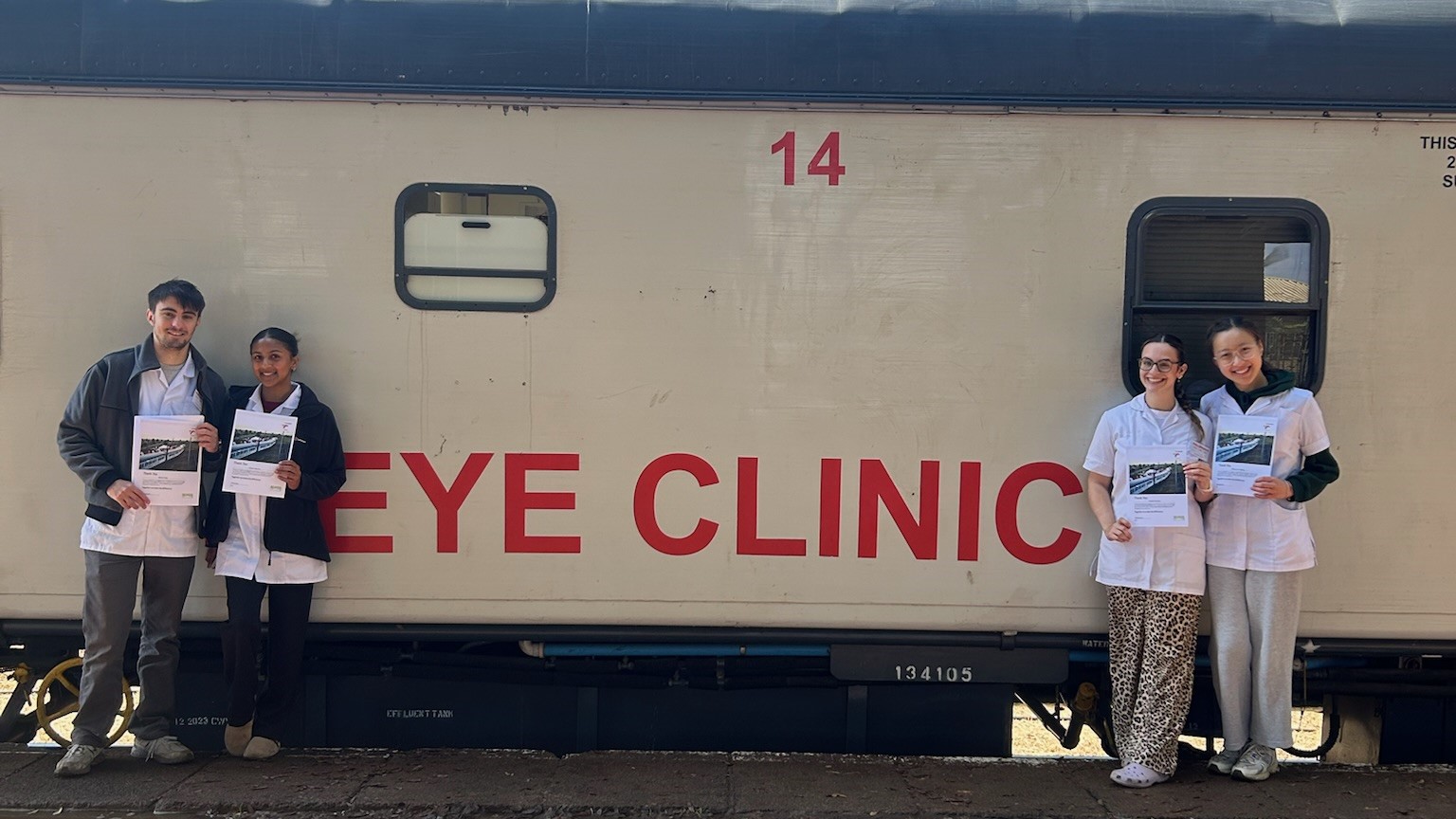
It is known as the Train of Hope, bringing life-changing health services to remote and disadvantaged communities where there is often one doctor for every 5,000 people.
Students from Glasgow Caledonian University were invited on board the Phelophepa train, a mobile clinic that weaves its way through rural South Africa.
The four final-year optometry students gained real-world experience working in the train’s eye clinic, alongside a team of full-time professionals.
The undergraduates have now returned from South Africa, where they spent two weeks on the train followed by two weeks studying at the University of the Free State in Bloemfontein.
On the Phelophepa train, they carried out eyesight tests and diagnosed eye conditions, giving advice to adults and children from one of the country’s neediest communities.
They gained valuable hands-on experience in everything from examining the retina to dispensing spectacles.
Amelia Murphy, 21, travelled with fellow fourth-year BSc Optometry students Shing Jen Wong, 21, Unnam Chaudry , 21, and Jamie Doig, 23, to the tiny village of Pienaarsrivier, 70km north of Pretoria.
“I applied to join the Phelophepa because it is important to make a difference to people who don’t have access to regular health care. But I also learned a lot from the patients I saw – around 10 a day compared to one a week we see at university,” said Amelia.
“It was also great to meet other optometry students at the University of the Free state. They were very welcoming, and we learned a great deal during our time there,” added Amelia.
Jen added: “The experience of studying at the University of the Free State was lovely. The clinical experience was very interesting as some of the students there carried out full eye examinations in different languages.
“On the Phelophepa train, we performed eyesight tests and provided prescription glasses. The reactions of people who could see properly for the first time in years – sometimes for the first time ever – will stay with me. It was as if they were seeing a new world. It was wonderful to see their faces light up.”
Unnam said: “I applied because I wanted to give back to the community. The experience made me feel so lucky and more aware of the global health disparity.”
Jamie said: “We saw patients with pathologies we wouldn’t see at university – we rarely see people with advanced cataracts as the condition is caught early in the UK and can be effectively treated.
“It was an invaluable experience and built up my confidence. I would like to return to Africa and do something along the same lines.”
Amelia added: “It was difficult to see people with advanced cataracts and tell them there was nothing we could do, as their condition was so severe.”
Unnam added: “We saw children as young as four and people in their nineties. We saw young boys with vernal kerato conjunctivitis, a rare and severe allergic eye disease that causes intense itching, redness and light sensitivity and is more common in boys. Unless treated, it can make them go blind.
“I would like to do this kind of work again, providing care in rural and deprived communities.”
The students slept on the train in temperatures that reached zero at night and during the day worked outside under the blazing sun.
“Our only hardships were the water being cut off for a couple of days, which meant we couldn’t shower – and the lack of Wi-Fi. But we didn’t have time to look at our phones anyway,” added Amelia. “But that was nothing compared to people who had walked 100km to attend the clinic and slept outside for two days in the freezing cold.”
Student volunteers have been integral to Phelophepa – meaning ‘good, clean health’ in Sesotho – since its beginnings in 1993. Since then, hundreds of student volunteers from Glasgow Caledonian University and elsewhere have benefited from the experience.
The pandemic prevented the University’s students from taking part since the last cohort returned from South Africa in 2019, and this year was the first time the University has been able to re-engage with this life-changing project.
Professor Niall Strang, Vision Sciences, said: “Not only has the train given our students the opportunity to put what they have learned into practice, it has provided them with learning opportunities that aren’t available here in Scotland.
“They were working with patients with a broad range of optical symptoms and conditions, and they had to make difficult clinical decisions and adapt their practice to their surroundings.
“They had to think and work differently to how they have been taught, but that’s a good learning process for them – and the whole experience was great for their personal development, broadening their horizons. Previous students have talked about the impact the Phelophepa train has had on their lives.
“The experience has given the students a good understanding of the realities and challenges of eyecare delivery and has improved their clinical skills as well as their confidence.