
Professor tells Government inquiry about benefits of structured and tailored exercise for older people
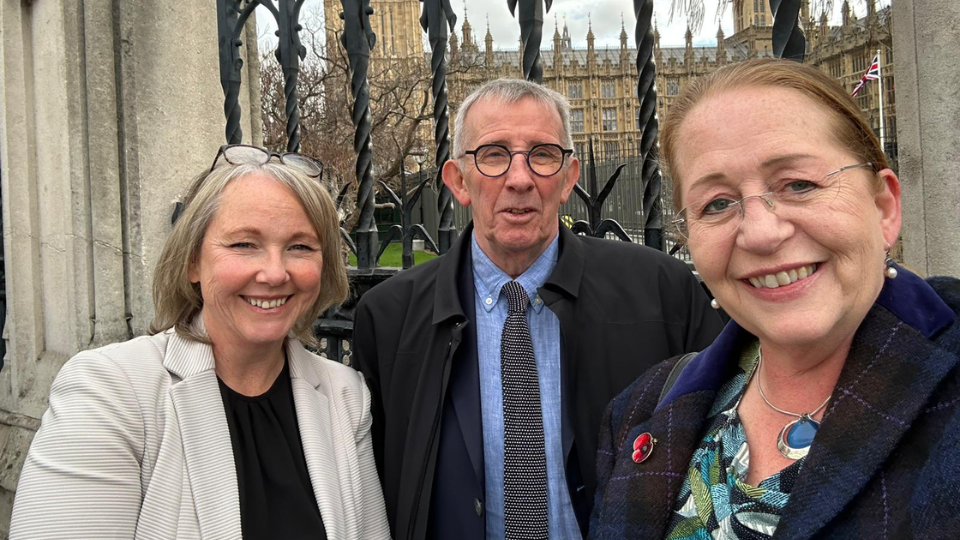
A Glasgow Caledonian University academic spoke in the House of Commons last week (Wednesday, November 12) as part of a discussion on how physical activity can improve the health and wellbeing of older adults.
Professor Dawn Skelton, Professor of Ageing and Health, Ageing Well Research Group, Research Centre for Health (ReaCH), was invited to contribute to the Health and Social Care Committee’s inquiry into Healthy Ageing: Physical Activity in an Ageing Society.
The inquiry is focusing on ways that physical activity can prevent and reduce ill health in older age, and how structured, progressive and tailored exercise can be an effective treatment to reduce the risk of falls and other age-related risks.
Professor Skelton told the inquiry that it was important to educate health professionals such as medical students and physiotherapists as well as care-home staff early in their training about the benefits of exercise as an effective treatment to make a difference to the outcome of falls, frailty and sarcopenia (the loss of skeletal muscle mass and strength as a result of ageing).
“Exercise as treatment does not receive the respect it deserves. If an effective prescription and dose is supported, it changes lives," said Professor Skelton. "Sadly, the public health message of ‘something is better than nothing’ means that older people are often offered ‘gentle, seated exercise’ and this does not help maintain independence or reduce falls.”
Training more people to deliver evidence-based exercise programmes that change behaviour and improve outcomes can be highly effective for frailer older people.
The use of volunteers, personal trainers or carers with limited knowledge of exercise physiology and the impact of medical conditions and medications, is unlikely to be effective. Training more specialist exercise instructors or clinical exercise physiologists would help reduce the waiting lists of physiotherapy services.
Professor Skelton said: “You need a skilled workforce. You need to work with the voluntary sector, and that voluntary sector needs to be supported to be skilled as well.”
She pointed out the difficulty in training carers in residential homes to help older people be more physically active due to the high turnover of staff, and carers’ fear of people falling.
The panel pointed to an annual Functional Fitness MOT (FFMOT) that allows social prescribers, practice nurses and health and exercise professionals to have regular discussions about physical activity and changes to functional fitness with age or changed activity by comparison with those of the same age, acting as a motivator to more activity.
“The FFMOT was developed by me and colleagues at Later Life Training in 2011 to help educate older people and the professionals that work with them about the physical activity guidelines for health and the importance of the different components of fitness that we need to age well and remain independent,” added Professor Skelton.
Professor Skelton was giving evidence alongside Professor Elizabeth Orton, Professor of Public Health, The University of Nottingham, and Professor Chris Todd, Deputy-Director, NIHR Policy Research Unit in Healthy Ageing.
The panel told the inquiry about the importance of making sure the Falls Management Exercise (FaME) programme – a cost-effective falls prevention programme – is more widely available to reduce falls and the fear of falling, and increase confidence in older people. FaME is a six-month, face-to-face group exercise programme aimed at improving strength and balance in people aged 65 and over.
“Older people at high risk of falls who take part in FaME, delivered by specialist Postural Stability Instructors, are reskilled to be able to get off the floor if they fall, but FaME improves stability and strength, builds confidence to re-engage in physical activity, and also helps reduce social isolation and improve mental health,” said Professor Skelton.
“Not only has FaME been shown to work in multiple large clinical trials, it has also been shown to work in the ‘real world’. It really changes lives, showing that frailty is not a one-way street to dependence, it can be reversed”.
Often specialist exercise services for older people such as FaME are commissioned for half the length of time shown to be effective in research trials, so more sustained opportunities to allow habit formation and behaviour change for self-directed physical activity are needed.
Professor Skelton told the inquiry: “Exercise needs to become as important as a drug prescription. Just as we wouldn’t give someone only half a dose of chemotherapy, we should ensure older people receive the full, evidence-based prescription of exercise. Exercise has fewer side effects and many benefits in preventing health conditions. It needs to have a much bigger priority in all healthcare training.”
The inquiry asked about the opportunities for expanding access to exercise for older people in under-represented communities such as ethnic minority groups, disabled people, and people of all genders. They were told that it was important to work closely with the communities themselves, problem solve their barriers and tailor messaging, timing of classes, delivery by bi-lingual or local champions, and offer different class formats to meet diverse needs. People in disadvantaged areas, for example, are more likely to attend classes if free transport is provided.
The role of digital technology in getting people active was discussed and it was pointed out that wearables, apps and small screens are not always suitable for frail older people with eyesight and joint problems. Technology that counts steps does not capture essential strength and balance work. However, there are apps that support strength and balance, which could support home exercises between face-to-face classes.
The panel emphasised the importance of classes and exercise groups to help with social isolation and loneliness and improve motivation.
Professor Skelton said: “I worry that the move to digital is going to lose that important face-to-face, social gaining, loneliness reduction model. A blended model would make all the difference for an older person.
“If we are looking at exercise as treatment, it has to be progressive but a lot of apps point to a video with the same exercises, so you lose the progression that is going to make a difference to physiology and to outcomes.”
The panel emphasised the importance of co-designing apps with older people to ask them what they want and what works for them – and of designing apps so they are adapted for diverse cultural groups.
Healthy life expectancy has stalled, with older adults spending more years in poor health. However, even small increases in physical activity among the older population can significantly improve health and delay the development of long-term conditions.
You can tune into Parliament TV on https://lnkd.in/e_rx3mZF and listen to Professors Skelton, Orton and Todd giving evidence to the inquiry.
Professor Dawn Skelton is a member of the Falls and Frailty programme and co-leads the Ageing Well Research Group. She is a member of the Community Rehabilitation Alliance and the National Falls Prevention Co-ordination Group. She is also Director of the not-for-profit training company Later Life Training.
Photo L-R - Professor Elizabeth Orton, Professor of Public Health, The University of Nottingham, Professor Chris Todd, Deputy-Director, NIHR Policy Research Unit in Healthy Ageing, and Professor Skelton, Professor of Ageing and Health, Glasgow Caledonian University.