
Food science student creates seaweed sculpture to tour Scottish schools and islands
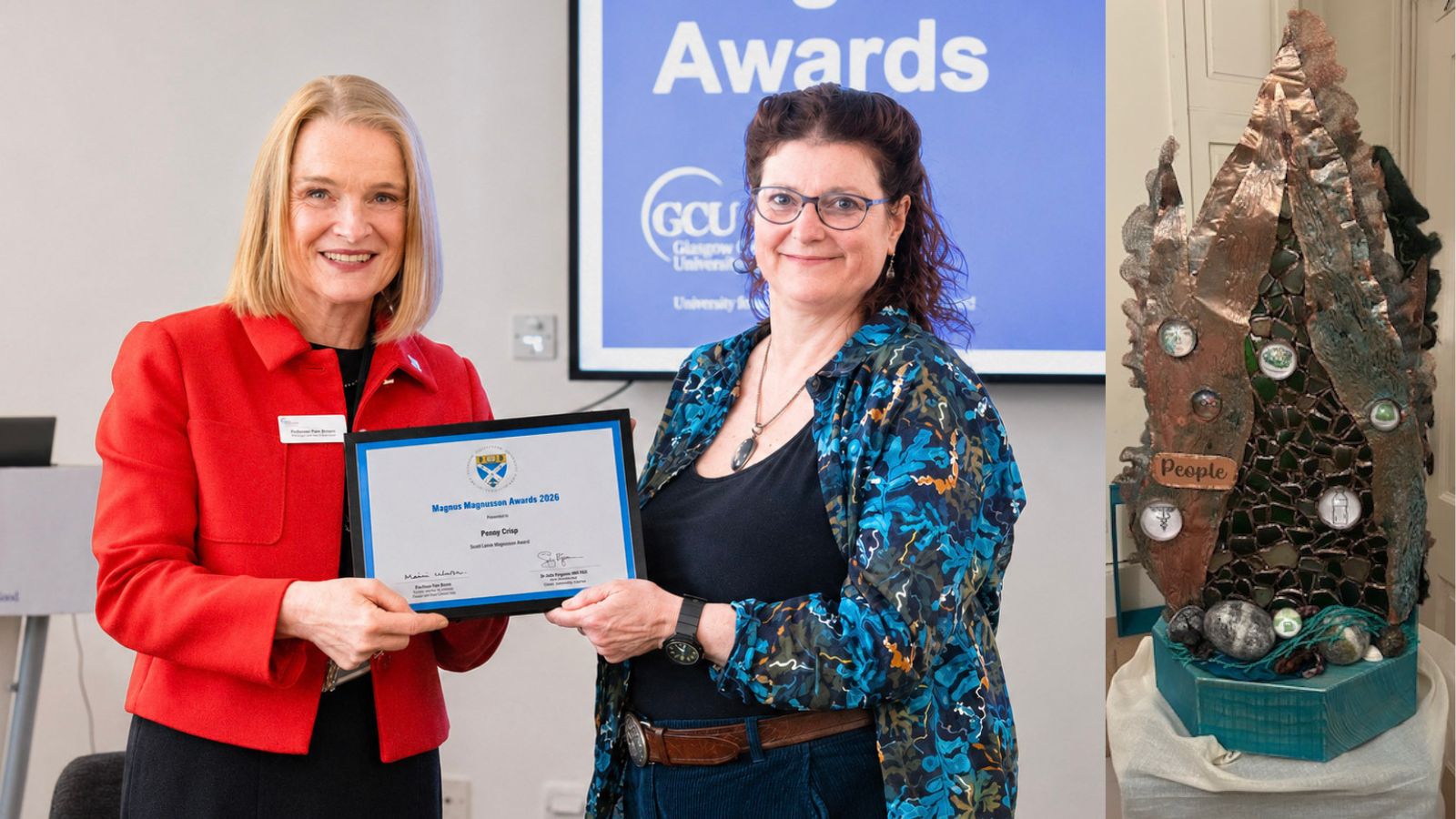
A Glasgow Caledonian University student has built a rotating sculpture combining sea glass, copper and farmed seaweed to bring the science of seaweed farming to life for schoolchildren across Scotland.
Penny Crisp, a fourth-year food science student, has received a Magnusson Award to support a touring workshop programme taking the piece into primary schools and communities across the inner and Outer Hebrides.
The Magnusson Awards, established in memory of broadcaster and former university chancellor Magnus Magnusson KBE, provide grants of up to £5,000 for student-led projects aimed at making a positive impact in communities at home and abroad. Since their launch in 2007, the scheme has supported more than 150 students working across dozens of countries, distributing over £600,000 in funding. The programme is overseen by his daughter, journalist and broadcaster Dr Sally Magnusson MBE.
Standing around three feet tall, Penny’s piece features two contrasting sides − one crafted from felt, the other from sea glass and copper − with farmed seaweed ropes strung between them to create an illuminated underwater diorama. A ‘lazy-susan’ mechanism allows it to spin, and image-filled bubbles on each face link to a set of discovery cards providing facts on topics from seaweed's nutritional benefits to its potential role in tackling climate change.
Penny said the idea had stayed with her since her time studying biotechnology at Clyde College, where she first proposed a sculpture in place of a standard infographic poster. “As an artist, this is probably my first true sculpture,” she said. “It was something I just had to do − it was inside me and needed expressing. It has turned out exactly as I imagined it and it brings me enormous joy.”
The piece has been designed to be accessible to primary school pupils while also appealing to scientific and industry audiences, with discovery cards that can be updated for different levels of learning − including the chemistry of alginate for secondary school workshops.
Penny has been collaborating with Seaweed Scotland, the Scottish seaweed industry body, and hopes to deepen her links with researchers at the Scottish Association for Marine Science (SAMS) in Oban, where the sculpture will be permanently displayed in the Ocean Explorer Centre when not on tour.
The project carries a broader message about the potential of seaweed farming to support coastal communities affected by the decline of the fishing industry, and its role in addressing food security, reducing reliance on plastics, and meeting the UK Government's net zero targets.
Penny said: “Growing up, I watched fishing communities struggle as that industry declined. Seaweed farming feels like it could be part of the answer − it's a genuine economic opportunity rooted in the same coastal landscapes and the same skills. That matters to me personally, not just scientifically.
“Perhaps young people will not grow up and move away from their communities if they see the potential in seaweed farming.”
The sculpture makes its first school visit to Hermitage Primary School in Helensburgh this term.
“Receiving this award recognises that using my instincts to express science artistically is well founded,” Penny said. “I had a moment in my youth when a scientific group came to our school and blew me away. I hope I can inspire at least one child in that same way − that would represent success.”