Overview
The MSc Medical Imaging is designed for radiographers ready to progress into enhanced or advanced roles.
Industry-informed curriculum and research-rich learning will prepare you to integrate imaging technologies, influence policy, and deliver enhanced and advanced practice across Scotland, the UK, and global healthcare systems.
Whether you’re advancing your current role or entering a new career path, this degree opens doors to leadership, innovation and meaningful impact in healthcare.
Computed Tomography Pathway
This page provides information about the Computed Tomography (CT) pathway, one of four pathways available within our MSc Medical Imaging course.
The Computed Tomography pathway provides a route to develop specialist knowledge and skills in CT and progress into enhanced or advanced practice roles.
You’ll gain an in-depth understanding of CT physics, image acquisition and safe practice, with a focus on how these principles support accurate diagnosis and effective patient care. Teaching integrates theory with clinical application, enabling you to apply evidence-based decision-making in your practice.
As you progress, you’ll link clinical experience with academic theory, building your confidence and employing evidence-based decision making in your practice.
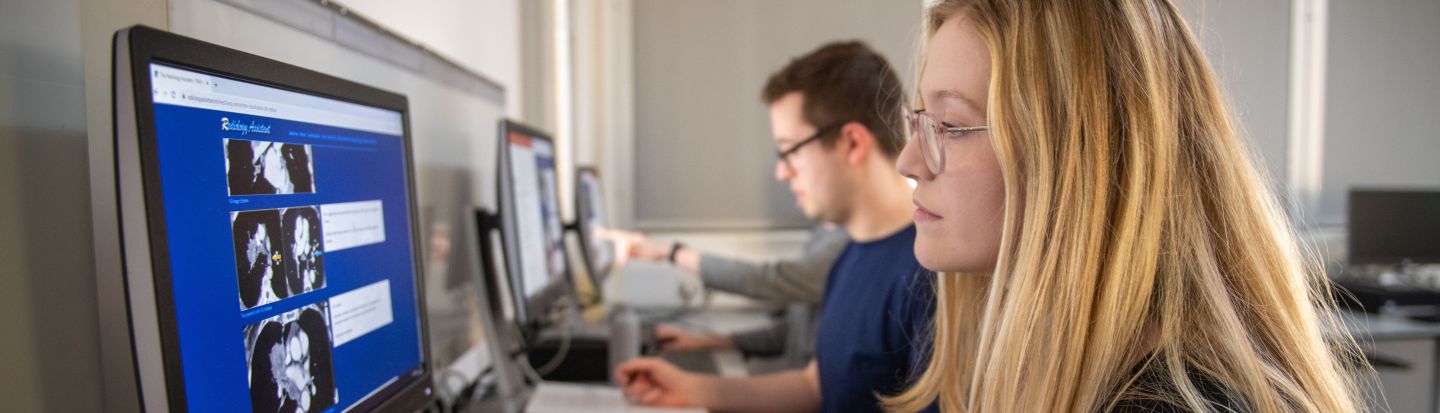
Your learning will be supported through CT simulation software, allowing you to hone your skills in a safe environment. Where available, short supervised placements further support your clinical development.
Whether you’re advancing your current role or entering a new career path, this degree opens doors to leadership, innovation and meaningful impact in healthcare.
Full-time study is available for UK and international applicants with at least two years of post-qualification experience, offering an intensive route to MSc completion in one year. Part-time study provides flexibility for UK-based professionals balancing work and study over three to five years.
Why study Medical Imaging (Computed Tomography) at GCU?
- Designed for qualified radiographers and healthcare professionals aiming to progress to advanced or enhanced practice through flexible pathway in CT.
- Supervised clinical exposure supports international students to understand UK CT practice, while home students can apply their existing experience and link day‑to‑day clinical work with the theory taught on the programme.
- State-of-the-art simulation facilities allow you to refine complex skills safely before applying them in clinical environments.
- Strong NHS and industry partnerships provide opportunities for service evaluation, leadership development, and research to transform imaging services.
What you will study
We aim to display the most up-to-date information possible.
The modules listed on this page and the Programme Specification are intended to give you an idea of what you may be able to study on this course. Please note that course content, modules, teaching and assessment may change each year and after you have accepted your offer to study at GCU. This might be because we are required to do so by law, by a governmental authority, regulator or accrediting body. We may also make changes for quality assurance reasons, or to enhance the course.
Careers
With growing global demand for advanced imaging expertise and digital health innovation, graduates are well positioned to progress into roles across clinical, academic and commercial settings.
You'll be prepared for advanced or specialist roles within CT imaging or sonography services, with opportunities in:
- leadership
- specialist CT practice or advanced practice
- education
- research.
Graduates go on to work across a range of settings, including:
- NHS Health Boards
- private imaging providers
- education and research
- international hospitals.
UK-based students often achieve career progression within the NHS, while international graduates may progress into advanced roles in their home countries or global healthcare organisations. Some graduates also choose to pursue further academic study, including doctoral-level research.
Strong links with NHS Scotland and industry partners, alongside GCU’s career guidance, provide valuable opportunities for networking and career development.
Course information
Take a virtual tour with us
Download the programme specification
In addition to the core modules that all students must undertake, some courses offer students a choice from a selection of optional modules to shape the focus of their degree. Optional modules where available, form part of the overall credit structure of the course.
Download the programme specification for a detailed breakdown of the course structure, including modules, what you'll learn and other useful information.
Terms and Conditions