Overview
Diagnostic radiographers play a vital role in modern healthcare. They use imaging technologies such as X-ray, computed tomography (CT), magnetic resonance imaging (MRI) and ultrasound to help diagnose illness and injury, supporting patients throughout their care journey.
Advances in imaging technology mean diagnostic radiographers play an increasingly important role in helping healthcare teams diagnose, treat and monitor patients.
This accelerated two-year MSc is designed for graduates who already hold a bachelor's degree and want to become highly skilled diagnostic radiographers. Whether you're looking to build on your existing knowledge or move into a new area of professional practice, you'll develop the technical expertise, scientific knowledge and clinical skills needed to succeed in modern healthcare.
Combining academic study with practical learning, the course prepares you for the realities of modern diagnostic radiography practice. You'll learn in both the classroom and clinical environment, applying your knowledge in real healthcare settings.
Through this course, you’ll benefit from extensive clinical placements. You'll complete around 1200 hours of clinical placement across Scotland, gaining experience in a wide range of imaging environments, including at specialist centres such as the Royal Hospital for Children and the Institute of Neurological Sciences. Working alongside experienced radiographers, you'll build the confidence, technical expertise and professional judgement needed for practice.
Just as importantly, you'll develop the professional values that underpin excellent healthcare, including compassion, dignity, respect, openness and accountability, preparing you to provide high-quality patient care throughout your career.
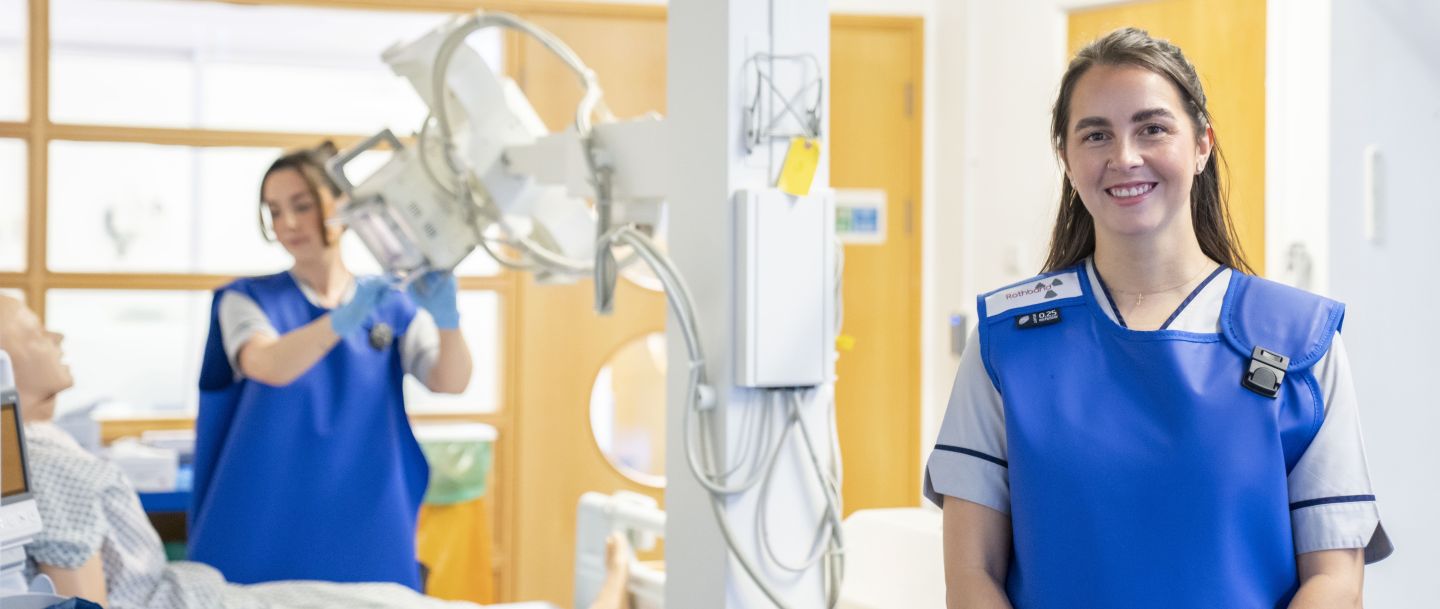
Small cohort sizes provide a personalised learning experience and close support from an experienced teaching team. You'll also develop your skills in our modern X-ray simulation facilities before applying them in clinical practice.
When you graduate, you'll be eligible to apply for registration with the Health and Care Professions Council (HCPC), opening the door to careers across the NHS, private healthcare, national screening programmes and specialist imaging services.
Why study Diagnostic Radiography (Pre-registration) at GCU?
- Learn in real clinical environments from your first year of study, undertaking with around 1200 hours of placement across Scotland, including specialist hospitals.
- Build confidence before placement in our modern X-ray simulation suite, developing your technical skills in a safe, supportive learning environment.
- Benefit from small cohort sizes, giving you personalised support from an experienced teaching team throughout your studies.
- Graduate ready for professional practice with an accelerated two-year master's that combines scientific knowledge, technical expertise and compassionate patient care.
- Learn from experienced radiography academics and practising professionals, with guest lectures from experts and service users bringing current clinical practice into the classroom.
Accreditations
What you will study
We aim to display the most up-to-date information possible.
The modules listed on this page and the Programme Specification are intended to give you an idea of what you may be able to study on this course. Please note that course content, modules, teaching and assessment may change each year and after you have accepted your offer to study at GCU. This might be because we are required to do so by law, by a governmental authority, regulator or accrediting body. We may also make changes for quality assurance reasons, or to enhance the course.
Please note that full module information is in the process of being finalised for publication and will be made available here shortly.
In the meantime, you can view and download the Programme Specification at the bottom of this page. This document provides an overview of the course structure, including indicative modules, learning content and further key information. The modules listed on the Programme Specification are for the current academic year and are intended to give you an idea of what you may be able to study on this course.
Careers
When you graduate, you'll be eligible to apply for registration as a Diagnostic Radiographer with the Health and Care Professions Council (HCPC), allowing you to practise across the UK.
Diagnostic radiographers work in a wide range of healthcare settings, including:
- NHS hospitals
- community healthcare services
- national screening programmes
- private practice.
As an essential member of the multidisciplinary healthcare team, you'll use advanced imaging technology to support diagnosis, treatment and ongoing patient care.
Our graduates have gone on to work in a variety of specialities both within the UK and worldwide, such as:
- computed tomography (CT)
- magnetic resonance imaging (MRI)
- nuclear medicine
- breast imaging or image interpretation.
Others have completed further postgraduate study to become qualified sonographers.
Many of our graduates have gone on to work internationally, with diagnostic radiography offering career opportunities in the UK and around the world. Professional and regulatory requirements vary between countries, so if you plan to practise outside the UK, you should check the requirements with the relevant body in your intended country of practice.
Course information
Take a virtual tour with us
Related courses
BSc (Hons)
Diagnostic Imaging
If you've got a passion for healthcare, and are motivated and driven to make a real difference to patients, this course can lead to a rewarding career in diagnostic radiography.
MSc
Medical Imaging
Advance your radiography career with MSc Medical Imaging. Choose a general degree or specialise in CT, MRI, AI or Ultrasound - the Ultrasound pathway also welcomes other registered healthcare professionals. Open to UK and international students.
Download the programme specification
In addition to the core modules that all students must undertake, some courses offer students a choice from a selection of optional modules to shape the focus of their degree. Optional modules where available, form part of the overall credit structure of the course.
Download the programme specification for a detailed breakdown of the course structure, including modules, what you'll learn and other useful information.
Terms and Conditions