GCU student shows compassion knows no borders
When the war in Ukraine began, we all sat in horror at the images unfolding before our eyes across social media and television screens.
Third year International Tourism and Events Management student Umran Ali Javaid was no different, but he had a plan.
Umran has been delivering ambulances to war-torn countries for a number of years, providing support to those caught amongst the chaos in the likes of Burma, Iraq, Syria and Yemen.
After witnessing Russia invade Ukraine, he knew a trip across Europe was going to be next on his list.
He said: “I always say it will be the last time because I want a life of my own and to be able to work on my passion for organising mega-events. However, every time I go, I just see the situation these people are in and realise that they have to come first.
It’s only a small thing that I’m doing but I’ve witnessed the difference the ambulances can make. Most places use vans, and patients sometimes hit their heads when they’re going in and out because they’re so low – British ambulances are much more suitable.”
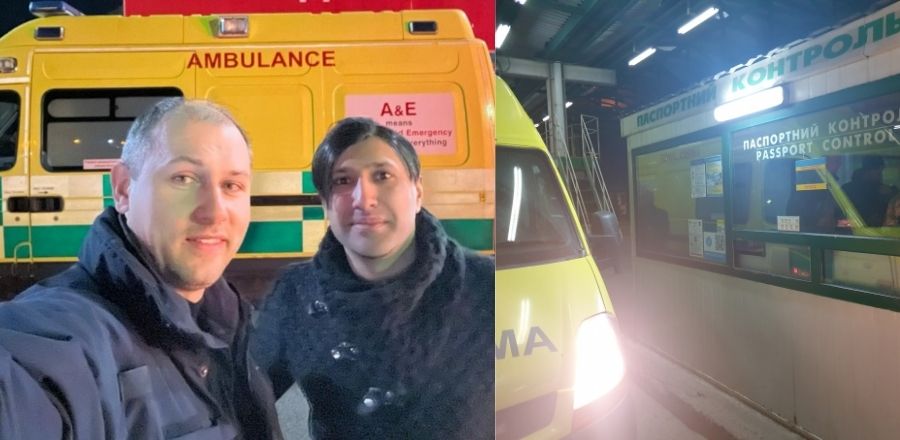
The thought of driving to a country caught in the midst of a deadly war would remain exactly that in most people’s heads, a thought. However, Umran has delivered more than 30 second-hand ambulances around the world. After buying his latest in Newcastle for £2,500, he was able to set off on his journey to the Polish-Ukrainian border.
Umran said: “I just used Google Maps to decide which route I was taking, but I had a couple of decisions to make along the way. I could have went from Folkestone in England to France and then on through Europe but I opted to go by boat to the Netherlands and then drove through Germany and into Poland. Thankfully driving an ambulance isn’t that hard! It was a smooth drive, definitely one of the easiest that I’ve done.
When I got to the border, I met a person from the Lviv Regional Centre for Emergency Medicine, who got the ambulance through customs in 20 minutes. They then told me that they would be using it straight away to evacuate people.”
He added: “I was made to feel really welcome and everyone was happy to see me; the border guards and Ukrainian refugees were all smiling. However, my mood changed when I saw what was going on around me - there were so many refugees.
I saw mothers who were clearly in pain from holding their babies, their arms were getting sore but temperatures were below freezing so they had to keep them close for warmth. There were also elderly women in wheelchairs, who just looked confused and dazed at everything that was going on. There were just thousands of people around me; I actually felt like I could have done more.”
Umran’s appeared on BBC Radio 5 Live and Sky News to speak about his latest experience but insists the focus should be on the frontline workers.
He said: “The real heroes are the medics, doctors and nurses that are working out there. I just drive there, drop off an ambulance and that’s it.
There’s obviously a bit of a risk with what I do, especially previously when I went to places like the Gaza Strip. I used to get really nervous about what could potentially happen to me but I don’t really think about these things now. It’s quite sad thinking about it, but you almost become numb because you’ve seen all there is to see.”
Umran added: “The best thing to come out of all this would be to encourage people to help out more but I do believe that everyone is trying their best. You can see how folk have got involved by donating clothes and even opening up their homes to those fleeing Ukraine.”
After starting the International Tourism and Events programme as a direct entrant in September, Umran probably didn’t expect to be planning a 1,500 mile trip into a war zone as his first event. So, what next?
“I’m actually going back to Ukraine to deliver another ambulance because I know I can still help these people. I do want to go back to normality but sometimes in life you do things for other people and that’s basically the point I’m at - I just want to make a small difference.”
By Ross Clark
Got an SHLS or GSBS story? Email me at Ross.Clark@gcu.ac.uk or message me on Twitter