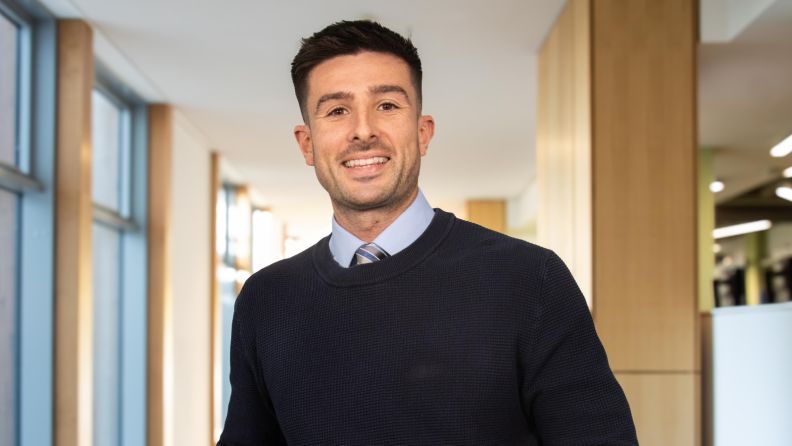
I'm Nathan Thomson, an Advanced Paramedic Practitioner and independent prescriber in Scotland, and the founder of Clinical Audit Compass.
I started in pre-hospital care as an ambulance technician in 2015, qualified as a paramedic in 2017 and moved into advanced practice in 2024. My week now covers remote consultations, treating people in their own homes and out-of-hours primary care. I also teach on the BASICS Scotland Pre-Hospital Emergency Care Course.
GCU has been part of my journey three times: my Certificate of Higher Education in Ambulance Studies when I trained as an ambulance technician, my Diploma of Higher Education in Paramedic Practice, and then, after a spell at the University of Stirling, my MSc in Advanced Paramedic Practice, which I graduate with this month.
Clinical Audit Compass is an app that lets healthcare professionals log a real case in under a minute, with no patient-identifiable data, and turn it into reflection, personal audit and a portfolio for appraisal and revalidation.
Every registered clinician has to show they are safe, reflective and still developing. In practice, most of us piece that evidence together weeks or months later, from memory, across notebooks, emails, documents and different online systems.
A lot of what clinicians actually do never gets recorded at all: the decision to keep someone safely at home, the difficult conversation, the safety netting, the teaching. If it isn't written down, it is very hard to learn from it or show it.
The result is that reflection often becomes a last-minute exercise before appraisal or revalidation, rather than something that helps you improve.
The moment it clicked for me was sitting down to reflect on a case I felt I had handled well, weeks after the event, and realising I could no longer remember the details that made it worth reflecting on. I knew there had to be a better way to capture practice while it was still fresh.
I work clinically three days a week, which is what has made it possible to build the business alongside it.
I had felt the problem for years, and every colleague I spoke to felt it too. The tools that existed were good at storing evidence, but none of them helped you capture it at the point of care, across professions, without recording patient information.
I also believe clinical tools work best when clinicians shape them. I'm still on the road every week, so I see the problem first hand and can test every change against real practice. At some point I realised that if I wanted it fixed, I would have to build it myself.
Almost everything was new to me. I'm a paramedic, not a software developer, so I had to learn how to write specifications, work with a development team and test every part of the app myself.
Regulation and safety were a big learning curve too. I built a full clinical safety case, data protection assessments, Cyber Essentials certification and an independent penetration test. It was hard work, but it has become one of the strengths of the business.
And then there is time. Fitting it all around shifts, study and family has meant being very deliberate about where my energy goes.
I've applied to a number of funding competitions and been turned down more than once. That was hard at first, but the feedback was fair: the product and the clinical need were strong, but I needed clearer evidence and a stronger commercial plan.
Rather than take it personally, I used that feedback to rebuild my plans. I've changed my pricing, introduced a free starting tier, and started building an evidence base with universities and researchers.
An early student trial also taught me a lot. People liked the idea, but uptake was low because it arrived at a busy point in their course. The lesson was that a tool has to fit into what people are already doing, at the right moment.
What I've learned is that a no is information. Ask for the feedback, act on it, and go again.