From predicting seizures minutes before they strike to protecting vulnerable patients without invading their privacy, researchers at Glasgow Caledonian University are proving that technology isn't just making healthcare smarter – it’s helping save lives.
At the University's School of Science and Engineering, we’re diagnosing conditions such as epilepsy with greater speed and accuracy and delivering breakthroughs that are improving patient safety in mental health wards. Through cutting-edge AI and digital innovation, these efforts are reshaping how care is delivered across the board.
For epilepsy patients, a diagnosis can be a long and difficult process. Clinicians currently must spend hours manually reviewing video footage and electroencephalography (EEG) data, searching for signs of seizures. It’s time-consuming and, even with expert eyes on the case, the process isn't foolproof. However, emerging AI-driven technology is set to change that.
Under the leadership of Professor Hadi Larijani, a team of researchers is developing a wearable AI-powered headset designed to transform epilepsy diagnosis. The project began as a six-month feasibility study in partnership with the William Quarrier Scottish Epilepsy Centre (WQSEC) and The Data Lab, where AI software was trained using historical EEG and ECG data to detect seizures with remarkable accuracy.
Following the success of the feasibility study, the team proposed embedding this AI into a wearable, wireless EEG headset, designed to offer continuous monitoring and real-time seizure prediction. Funding was subsequently secured from Scottish Enterprise’s High Growth Spinout Programme (HGSP), accelerating the transition from software prototype to hardware development. A working prototype of the headset has now been developed.
The project garnered political and public attention when Scottish Labour leader Anas Sarwar visited the WQSEC, witnessing first-hand the system's potential. He praised the initiative as an example of how technology can drive transformative change in healthcare.
Professor Hadi Larijani outlines a new AI headset
In recognition of its innovation and commercial promise, the headset project was then accepted into the Converge Challenge, a national competition that supports entrepreneurial projects emerging from Scotland’s universities. As part of this, Professor Larijani’s team is receiving intensive training and support to help prepare the product for market.
“The support we’ve received, including from political figures, has been overwhelming,” says Professor Larijani. “And being accepted into the prestigious Converge Challenge marks a major step towards commercialisation.”
Notably, this AI-powered headset with a wireless monitor can now predict epileptic seizures with 95% accuracy up to 30 minutes in advance. This breakthrough offers patients and their families an early warning system, reducing risks and improving quality of life.
To ensure the headset meets real-world needs, the team launched a national survey in late 2024, inviting input from healthcare professionals, patients and carers to shape the product’s final design − reinforcing the project's commitment to collaborative, patient-led innovation.
“We conducted a wide survey on the prototype,” Professor Larijani explains. “We’ve seen overwhelming support from families. One parent told us, ‘Any device that gives us warning means we can protect and support our daughter from seizure-related harm.’ This underscores how vital this innovation is.
“Our project highlights the power of interdisciplinary collaboration, bringing together expertise in computer science, data analytics and clinical research to create practical solutions for real-world healthcare challenges.”
New radar-based mental health monitoring system offers continuous, anonymous observation.
But epilepsy isn’t the only area where Glasgow Caledonian University is making an impact. In mental health facilities, balancing patient safety with privacy has long been a challenge. Traditional monitoring methods can feel intrusive, but removing observation entirely can leave vulnerable individuals at risk.
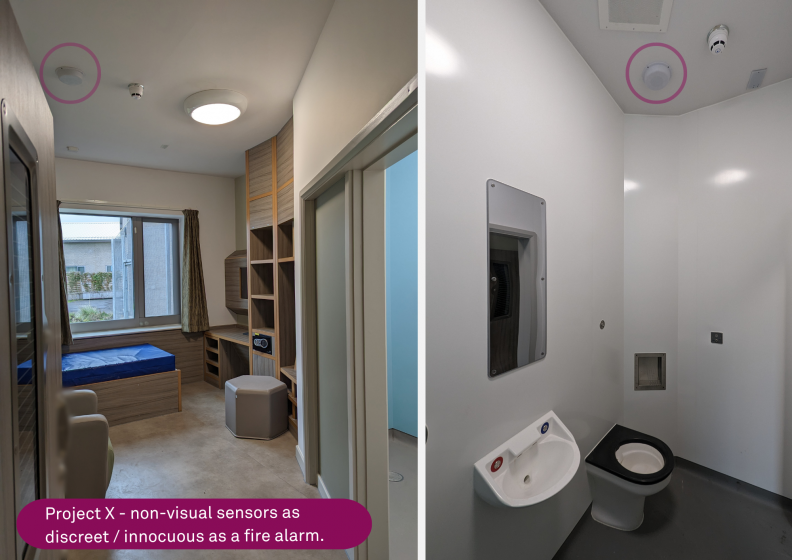
To address this, the University partnered with healthcare technology company Safehinge Primera to develop a ground-breaking digital monitoring aid that ensures safety without compromising dignity. Instead of using cameras, the system employs discreet, non-visual sensors to track a patient's movement and position in high-risk areas. This means clinicians can be alerted to potential issues, such as falls or distress, without the need for invasive surveillance.
This innovative approach emerged from an Innovate UK Knowledge Transfer Partnership (KTP) project and is already gaining national recognition. At the heart of its development is Colm Dowling, a Safehinge Primera employee and current Glasgow Caledonian PhD student, whose work was recently recognised with the prestigious Future Leader Award at the 2024 UK Knowledge Transfer Partnership Awards.
“It's a huge personal honour,” says Colm. “But, more importantly, it recognises how much of a difference this project can make in patient care. The traditional approach to observations – checking in on patients every 15 minutes – is not only intrusive and disruptive to sleep, it also means staff are only seeing what's happening about 3% of the time. Our technology aims to provide 24/7 real-time insights without compromising privacy.”
The system uses low-power radar to monitor patient activity and detect critical events such as a person collapsing or being near a ligature point. Rather than capturing visual data, it generates a completely anonymous ‘point cloud’ – a digital model that reflects a patient's movements and position without revealing any identifying features.
“This is about ethical, non-invasive innovation,” Colm explains. “The information – whether someone is standing, lying down, or moving – is displayed via a mobile app and dashboard, ensuring staff remain informed and can act quickly, wherever they are on the ward.”
Professor Craig Thomson, Associate Dean Research in the School of Science and Engineering, emphasised the broader implications of these advancements.
“With AI and digital technology rapidly evolving, the potential for healthcare innovation is enormous,” he says. “Glasgow Caledonian is proving that when research meets real-world challenges, the results can be life changing. By developing intelligent, patient-centred solutions, the University is not just advancing technology, it's redefining the future of healthcare.
“As these projects move forward, the potential to scale, commercialise and integrate these technologies into everyday healthcare is within reach. The question now isn’t just if these innovations will change lives, but how soon.”

Share this article