Our Facilities
The School of Health and Life Sciences offers students and businesses access to state-of-the-art learning and research facilities across all our departments. We have a range of unique facilities and expertise for experimental work, testing, analysis and professional training.
Vision Centre
The Vision Centre trains Optometrists, Dispensing Opticians and Orthoptists – the only institution in the UK to do so. The Vision Centre at GCU is equipped with the latest technology to provide a wide range of regular and specialist eye-examinations as well as Contact Lenses and spectacle dispensing. During teaching semesters patients are typically examined by students under the direct supervision of experienced and qualified clinical staff. In addition, the Vision Centre is home to a number of highly experienced clinicians who provide a full range of eye examination and dispensing services to NHS and private patients throughout the year.
Interprofessional Simulation Centre
Our state-of-the-art Interprofessional Simulation Centre provides simulation based education for GCU allied health professions, nursing, social care and Scottish Ambulance Academy students.
Utilising the latest technologies to support health and social care practitioners with their learning and development, the learning opportunities extend from communication and non-technical skills, through fundamental assessment and examination techniques and on to advanced interprofessional scenarios.
Delivered within a non-threatening environment, away from the pressure and anxieties related to actual patient/service user contact, it enables the development of safe and confident practitioners in preparation for entering the workplace.
In addition to pre-registration education, the facilities are also utilised for post-registration qualifications, CPD and research.
Human Performance Laboratories
State-of-the-art human performance laboratories with capability to measure functional performance and activities of living in controlled and free-living conditions, including 3-D motion capture, ultrasound techniques, force and pressure analysis, muscle function and strength, metabolic and physical activity monitoring. Additionally, we have capacity for computer-aided design and manufacture (rapid prototyping) of novel orthotic devices.
Biological and Biomedical Sciences Laboratories
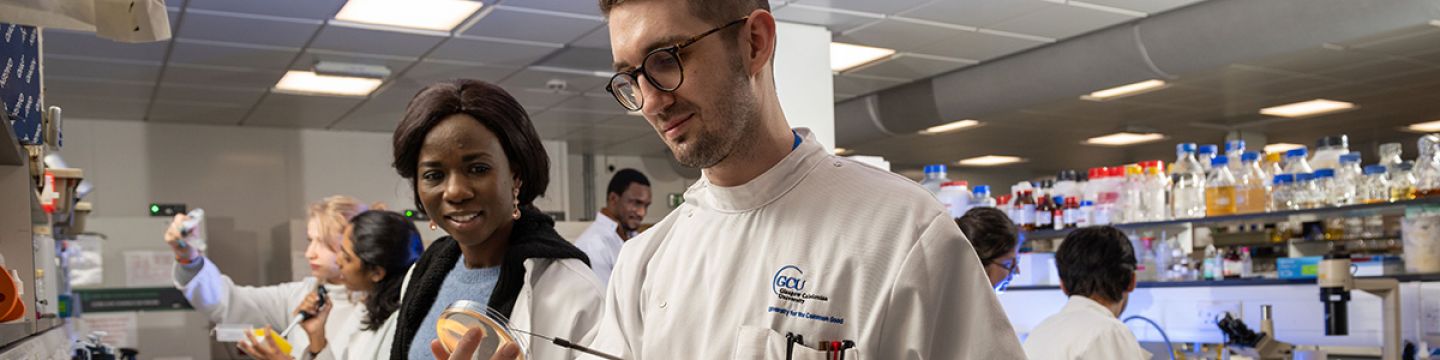
The Department of Biological and Biomedical Sciences has expertise in the molecular mechanisms behind a number of chronic diseases, public health and infections and the development of novel therapeutics. We also offer expertise in the microbiology, safety, chemistry and structure of food and work closely with corporate and public sector organisations.
The department houses state of the art microscopy systems in the well-equipped Charles Oakley Laboratories. The cell-signalling and bio-imaging unit (CSBU) is supported by SULSA and includes a wide variety of systems including confocal and live imaging, calcium imaging and microinjection. More information and testimonials can be found on the cell-signalling and Bio-Imaging Unit webpages.
We also host the Scottish Pulmonary Vascular Unit (SPVU) complementing clinical research with patient care. The main focus is to understand the profound changes of pulmonary arteries in patients with pulmonary hypertension via cellular studies and the development of novel therapies.
For our public health and infections work, the laboratory has a micro-containment suite to facilitate research on pathogens that require specialist containment and disposal. This space has accommodation for both bacterial, fungal and viral research.
The GCU Skin Research Tissue Bank which has been in operation since 2011 and operates under its own Governance providing well annotated normal and diabetic tissue samples to support research into human skin disease. The tissue bank is currently being extended to include donations from other skin conditions including inflammatory skin disorders, genetic skin disease and scleroderma, and bacterial infections to enable correlations with skin disease and shifts in the skin microbiome.
In our Food Science laboratory, we have dedicated instrumentation which allows for the rapid detection and classification of bacteria relevant to food safety. In addition to consultancy and research work, the department provides professional courses in food safety for companies, leading to certification from the Royal Environmental Health Institute of Scotland (REHIS).
Psychology Laboratories
GCU has psychophysiology and cyberpsychology laboratories with digital recording facilities.
University facilities
The University’s city centre campus is amongst the most modern in the UK, with over £45 million invested in new facilities such as our health and fitness centre (Arc) and The Sir Alex Ferguson Library.
Find out more about the university's facilities.